

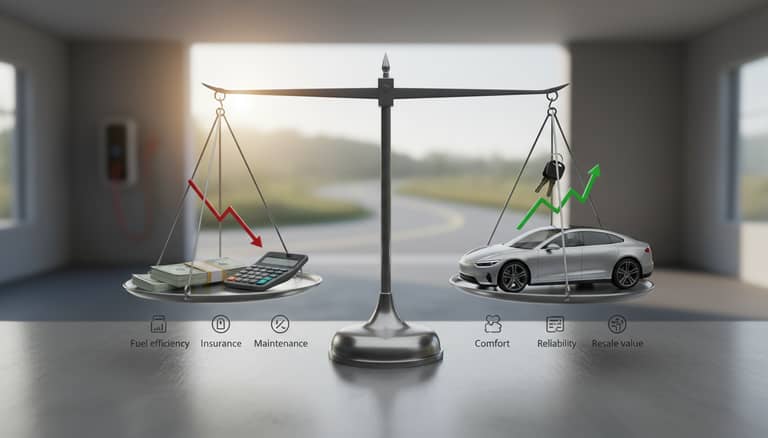
Car Buying Cost-Benefit Analysis: Weighing Ownership Against the Data
Written with AI assistance under our editorial guidelines
Owning a car in 2026 has become far more expensive and complex than five years ago, with new cars averaging $48,700 and used cars at $25,100. While alternatives like rideshares, e-bikes, and public transit have grown increasingly viable in urban areas, the decision to buy now depends on weighing substantial monthly payments and hidden costs against genuine transportation needs rather than societal pressure or status.
If you think buying a car in 2025 is anything like it was five years ago, you’re in for a harsh awakening. The game has changed, and the stakes are higher than ever. With the average new car price hovering around $48,700—almost the same as a starter home’s down payment—and used cars now averaging $25,100, owning a car has morphed from a symbol of independence into a high-stakes gamble. The numbers don’t just tell a story; they scream it. Negative equity is a looming specter, monthly payments now rival mortgages, and the fine print hides more traps than ever before. But beyond the shocking price tags, there’s a deeper, more complex web of costs and benefits. This isn’t about emotional appeals or glossy showroom floors. It’s about the raw, unfiltered reality of what you gain—and what you stand to lose—when you decide to buy a car in 2025. Ready for the truth? Let’s cut through the noise.
Why car buying is more complicated than ever
The evolving meaning of car ownership
Car ownership used to be a rite of passage, a loud declaration of freedom. Now, it’s more of a calculated risk than a coming-of-age story. Today's urban landscape is littered with alternatives—rideshares, e-bikes, public transit, and even subscription vehicles. The value proposition has shifted: is it really about the open road, or is it about monthly survival?
Urban commuters using alternative transport methods, a visual representation for car buying cost-benefit analysis in 2025.

"Owning a car isn’t a rite of passage anymore—it's a calculated risk." — Alex, industry analyst
According to the Deloitte 2025 Global Automotive Consumer Study, consumers are pivoting towards practical considerations—cost, convenience, and flexibility. This shift is echoed in major cities worldwide as personal vehicle ownership rates stagnate or even decline, while alternative mobility solutions soar.
Societal pressures and psychological traps
Everyone remembers their first car, but now, the purchase is often more about keeping up appearances or managing anxiety than genuine need. Societal expectations, the lure of status, and FOMO (fear of missing out) influence decisions far more than we’d like to admit. The auto industry capitalizes on these triggers, offering incentives that look irresistible but often mask hidden costs.
- Perceived independence: The idea of freedom is weaponized in advertising, yet most cars spend 95% of their life parked.
- Social validation: Newer, flashier models promise status but deliver only fleeting satisfaction while draining bank accounts.
- Sunk cost fallacy: Buyers stick with expensive vehicles for too long, afraid to “lose” money already spent.
- Financial illusion: Clever financing makes monthly payments look manageable while total costs balloon.
- Convenience myth: Ownership is sold as convenient, but maintenance, insurance, and parking say otherwise.
The hidden benefits of a car buying cost-benefit analysis—what the experts rarely tell you—include freedom from debt, better allocation of resources, and a more adaptable lifestyle.
The rising complexity of the auto market
Walk into any dealership or browse online, and you'll be bombarded by an overwhelming array of choices—SUVs, EVs, hybrids, crossovers, and more. Add the layer of financing options, rebates, and tech features, and it’s no wonder decision fatigue sets in. According to Cox Automotive, 2025, the average consumer now spends over 14 hours researching before making a decision.
AI-powered services like futurecar.ai exist precisely to help buyers cut through this chaos. By using advanced analytics, they provide personalized recommendations and side-by-side comparisons, empowering you to make an informed, nuanced choice based on your true needs—not just slick marketing.
Breaking down the real costs of buying a car
Upfront costs you can’t ignore
Sticker price is only the start. Taxes, registration, dealer fees, and “mandatory” add-ons can drive the true upfront cost thousands above the advertised number. According to the Saga 2025 Car Buying Trends, buyers routinely underestimate these extras by 10-15%.
| Type of Car | Average Price (2025) | Typical Upfront Fees | Total Initial Outlay |
|---|---|---|---|
| New | $48,700 | $2,500-$3,500 | $51,200-$52,200 |
| Used | $25,100 | $1,200-$2,000 | $26,300-$27,100 |
| Certified Pre-Owned | $32,000 | $1,700-$2,500 | $33,700-$34,500 |
Table 1: Real-world cost comparison for new vs. used vs. certified pre-owned cars in 2025
Source: Original analysis based on Saga, 2025, CarEdge, 2025
These numbers reflect only the beginning. Financing, insurance, and ongoing costs—often obscured in the sales pitch—can multiply your financial exposure quickly.
The silent killer: Depreciation
Depreciation is the vampire in your garage. On average, new cars lose 20-30% of their value the moment you drive them off the lot—a reality that rarely makes it into sales conversations. Within five years, that shiny new vehicle is often worth less than half its original price, with electric vehicles (EVs) and luxury models sometimes falling even faster.
Photo: Car fading into shadow, visual metaphor for depreciation in car buying cost-benefit analysis

Recent studies, including CarEdge, 2025, find that the average new car depreciates by $15,000-$20,000 within its first five years, depending on make and model. Used cars fare better but are still susceptible, especially when market trends shift or new technology becomes obsolete overnight.
Financing and loan traps
Financing can be a double-edged sword. With average new car monthly payments now at $756 and used car loan interest rates climbing to 14% APR, the real cost of borrowing is absurdly high. Long loan terms (72 months or more) mean you pay more in interest and risk going “underwater”—owing more than the car is worth.
Step-by-step guide to mastering car buying cost-benefit analysis
- Calculate total purchase cost: Include taxes, fees, and dealer add-ons.
- Factor in financing: Compare interest rates and total loan costs, not just monthly payments.
- Estimate depreciation: Research historic depreciation rates for your target model.
- Project insurance and maintenance: Get real quotes, not just averages.
- Analyze opportunity cost: Consider what your money could earn elsewhere.
- Simulate worst-case scenarios: Factor in job loss, major repairs, or increased insurance.
- Decide based on total cost of ownership—not emotion or marketing.
According to Cox Automotive, 2025, negative equity is at record highs due to long loan terms and high prices. Don’t let financing turn a practical purchase into a lifelong burden.
Insurance, taxes, and the fine print
The recurring costs of car ownership are where many buyers lose track. Insurance, which varies wildly by state, vehicle type, and driver profile, can add up to $1,500–$2,500 annually for new vehicles—and even more for certain models or locations. Taxes don’t disappear after purchase: annual property taxes or excise taxes exist in many regions.
Urban dwellers also contend with permit fees, parking costs, and congestion charges. According to Saga, 2025, insurance rates for SUVs and EVs are on the rise, reflecting increased repair costs and theft rates. Don’t gloss over these details—they’re the difference between a manageable budget and a slow-motion financial disaster.
The benefits no one talks about
Freedom, convenience, and social status
Despite the minefield of hidden costs, car ownership still delivers intangible benefits: the freedom to travel on your terms, perceived convenience, and—let’s be honest—a dose of social status. The ability to decide when and where you go, without relying on the whims of ride-hailing algorithms or transit schedules, remains a powerful draw.
"Sometimes, the value is in what you can’t measure." — Jordan, urban planner
Yet, these psychological benefits are often overvalued. Studies show the “new car high” fades quickly, replaced by payment fatigue and maintenance headaches. Still, for some—especially those in remote areas or with unique mobility needs—the benefits are real and enduring.
Life scenarios where buying makes sense
There are scenarios where car ownership is not just justified, but essential:
- Rural living: Alternatives are often nonexistent, making ownership indispensable.
- Large families: Rideshare and car-sharing costs add up fast for groups.
- Irregular schedules: Shift workers or night owls can’t rely on public transit.
- Frequent long-distance travel: Owning is cheaper and more flexible than renting or ridesharing.
- Special needs: Adapted vehicles for medical or accessibility reasons are rarely available in sharing fleets.
Unconventional uses for car buying cost-benefit analysis:
- Calculating the break-even point for gig drivers (Uber, Lyft)
- Assessing the impact on home prices for neighborhoods with or without parking
- Determining the real ROI for company car policies
- Using ownership costs as leverage in salary negotiations
- Benchmarking insurance costs for alternative-fuel vehicles
When owning is cheaper than alternatives
There are cities and circumstances where outright ownership trumps rideshare, leasing, and public transport on cost and convenience—especially for high-mileage drivers. Here’s how it breaks down in 2025:
| City | Annual Mileage | Ownership Cost | Leasing Cost | Rideshare Cost | Public Transit Cost |
|---|---|---|---|---|---|
| Houston | 15,000 | $10,200 | $11,500 | $15,300 | $2,400 |
| Los Angeles | 12,000 | $9,800 | $10,900 | $13,700 | $1,900 |
| Chicago | 9,000 | $8,400 | $9,800 | $11,600 | $1,800 |
| Atlanta | 10,500 | $9,900 | $10,400 | $13,000 | $2,150 |
Table 2: Cost-benefit analysis—ownership vs. rideshare vs. leasing in major US cities, 2025
Source: Original analysis based on CarEdge, 2025, Cox Automotive, 2025
The math is clear: the more you drive, the more ownership makes sense. But for low-mileage city dwellers, alternatives may win out— especially when factoring in parking, congestion fees, and urban stress.
The hidden costs that will haunt you
Maintenance, repairs, and the unexpected
Owning a car isn’t just about gas and oil changes. Modern vehicles, especially those loaded with tech, can hit you with surprise repairs that blow up your budget. A failed sensor here, a mysterious warning light there—and suddenly you’re parting with hundreds or thousands you hadn’t planned for.
Greasy mechanic hands working under a car at night, capturing the unpredictable cost of maintenance in car buying cost-benefit analysis

Extended warranties rarely cover everything. According to CarEdge, 2025, average annual maintenance and repair costs for new vehicles can exceed $1,400, with outliers much higher for certain brands and models.
The opportunity cost of tying up your cash
Every dollar sunk into a car is a dollar not working for you elsewhere. That’s the real killer—opportunity cost. Monthly car payments delay everything from retirement savings to vacations, investments, or even buying a home. For most, the true financial impact won’t show up on a spreadsheet—it’ll hit when you realize what you gave up along the way.
"Every dollar in a car is a dollar not building your future." — Taylor, personal finance blogger
The relentless push for longer loan terms and higher payments means you might spend a decade “owning” your car—while missing out on compounding returns from smarter investments.
Environmental and societal impacts
It’s no secret: car ownership carries a carbon footprint that’s hard to ignore. Manufacturing, fuel, maintenance, and even disposal all contribute to environmental stress. Gridlocked roads choke cities, and urban planners in places like New York, Paris, and Amsterdam are actively discouraging private car ownership by reducing parking, increasing tolls, and expanding alternatives.
More cities are implementing congestion fees, banning older vehicles from central zones, and prioritizing bike and pedestrian infrastructure. The hidden cost isn’t just personal—it’s societal. The more we cling to the old ownership model, the slower progress becomes on everything from climate change to urban livability.
Debunking the biggest car buying myths
‘A new car is always a bad investment’
It’s tempting to parrot the idea that new cars are financial poison. But for buyers who prioritize the latest safety tech, warranty coverage, and customization, a new car can make sense—especially in segments where used prices are nearly as high as new.
- Red flags to watch out for when buying a new car:
- Heavily marked-up “market adjustments” or dealer fees
- Long loan terms that mask true cost
- Promises of “zero maintenance” that don’t match reality
- Suspiciously high trade-in offers contingent on financing
- Vehicles with complex, unproven technology (potential repair nightmares)
In some cases, strong incentives, rebates, and low-interest financing can tip the scales. The key is to analyze your unique situation, not follow blanket rules.
‘Leasing is throwing money away’
Leasing isn’t always the villain—it can be the smarter move for buyers who crave flexibility, drive limited miles, or want to avoid the headaches of long-term ownership. In 2025, the gap between leasing and buying is narrower than ever, thanks to high used car prices and manufacturer incentives.
| Scenario | Total Lease Cost (3 Years) | Total Purchase Cost (3 Years) | Key Consideration |
|---|---|---|---|
| Low-mileage driver | $15,900 | $21,000 | Leasing often wins |
| High depreciation | $17,200 | $22,700 | Leasing reduces exposure |
| Tech enthusiast | $16,800 | $20,500 | Leasing allows regular upgrades |
Table 3: Leasing vs. buying—total cost breakdown by scenario, 2025
Source: Original analysis based on CarEdge, 2025, Cox Automotive, 2025
The trick is to run the numbers for your scenario. Leasing can be “throwing money away” if you exceed mileage, return a damaged car, or miss incentives—but for many, it’s smart risk management.
‘Car ownership equals independence’
Let’s get real: In dense cities with robust public transit and ridesharing, car ownership is sometimes more of a shackle than a key to freedom. Remote work, telecommuting, and the gig economy have radically changed mobility needs.
Empty highway at dawn, representing solitude versus the traditional view of independence in car buying cost-benefit analysis

Urbanization is making car-free living increasingly viable—and, for some, preferable. What was once a symbol of autonomy can now look like dead weight.
Advanced strategies for smart car buyers
Timing your purchase for maximum value
Market timing isn’t just for Wall Street. In the car world, certain months, quarters, and even days of the week deliver better deals. End-of-year clearances, new model launches, and quarterly sales targets all influence pricing.
Timeline of car buying cost-benefit analysis evolution
- Pre-internet era: Buyers relied on word-of-mouth and dealer honesty.
- Online revolution: Access to pricing data shifted power to consumers.
- AI and analytics (2020s): Services like futurecar.ai bring precision to decision-making.
- Supply chain disruptions (2022-2024): Scarcity and price volatility became the norm.
- 2025 and beyond: Negotiation depends on access to real-time data—those without it overpay.
Research from Cox Automotive, 2025 confirms that December, March, and August are historically the best months for car deals, while weekends and end-of-quarter days offer extra leverage.
The power of negotiation and research
Negotiation isn’t dead—it’s evolved. Armed with online price trackers, buyer incentives, and dealer holdback data, savvy consumers routinely save thousands. The key? Preparation. Know the invoice price, current incentives, and recent sales in your area.
AI-powered sites like futurecar.ai aggregate this intel, giving you an edge before you ever set foot in a showroom. Use these resources to compare vehicles, features, and real-world pricing—don’t rely on gut instincts or sales pressure.
How to calculate your true break-even point
Break-even analysis means pinpointing when (or if) the total cost of ownership justifies your investment compared to alternatives. Factor in all costs: purchase price, financing, insurance, maintenance, depreciation, and opportunity cost.
Key terms in car buying cost-benefit analysis:
- Depreciation: The rate at which your car loses value over time. Fastest in new cars, slower in certain used models.
- Total cost of ownership (TCO): The all-in cost, including purchase, maintenance, insurance, taxes, and depreciation.
- Negative equity: Owing more on your loan than the car is worth—common with long-term financing.
- Opportunity cost: Potential gains lost by investing cash in a car instead of assets with higher returns.
- Residual value: The projected value of your car at the end of ownership or lease.
Knowing these terms—and doing the math—turns you from an emotional buyer into a strategic investor.
Case studies: Regret, reward, and everything in between
The happy minimalist
Meet Jamie, who sold her car after moving to a walkable city. At first, she feared losing freedom but gained cash flow, peace of mind, and more time for what mattered. Today, she cycles everywhere, rents a car only when needed, and invests the savings.
Former car owner cycling through city with a smile, embracing the minimalist car buying cost-benefit analysis philosophy

The status-driven buyer
Alex always wanted the latest SUV. He splurged—financed for 84 months, loaded with features. For a while, it was thrilling. But the monthly outflows, mounting maintenance, insurance, and rapid depreciation led to regret. The tipping point: getting “upside down” on his loan, forced to keep a vehicle he no longer loved.
Hidden costs—especially negative equity and surprise repairs—turned a status symbol into a financial weight. Alex’s experience is a cautionary tale: buy for yourself, not for others.
The calculated commuter
Taylor spent months analyzing cost, mileage, and incentives using tools like futurecar.ai. She negotiated hard, got a solid deal, and stuck to regular maintenance. The result? After three years, she sold her car at a minimal loss and felt the investment had paid off.
Priority checklist for car buying cost-benefit analysis implementation
- Set a clear budget and stick to it—even if it limits your options.
- Research depreciation rates and factor them into your calculation.
- Compare insurance quotes for multiple vehicles before committing.
- Estimate annual mileage and match ownership type accordingly.
- Assess total cost of ownership versus alternatives.
- Commit to regular maintenance to minimize surprise expenses.
- Use AI-powered comparisons for objective, up-to-date advice.
The future of car buying: Disruption and new realities
The impact of electric vehicles and new tech
EVs are changing the game, but not always in ways buyers expect. While running costs are lower—zero gas, fewer moving parts—upfront prices are high, and depreciation can be brutal, especially as newer tech rapidly supersedes older batteries and features.
Futuristic electric car charging in a modern city, visualizing technology’s impact on car buying cost-benefit analysis

Battery longevity, charging infrastructure, and resale values are the wildcards. According to the Deloitte 2025 Global Automotive Study, over 70 EV models are available in 2025, but incentives, range, and total cost of ownership vary dramatically.
Subscription models, car sharing, and mobility-as-a-service
The “Netflix for cars” trend—subscription models, car sharing, and mobility-as-a-service (MaaS)—offers flexibility with less commitment. For urbanites and occasional drivers, these models can drastically lower costs and eliminate headaches.
Key mobility terms:
- Car sharing: Short-term rentals by the hour or day, often app-based.
- Subscription service: Pay a monthly fee for access to a fleet of cars, insurance, and maintenance.
- Mobility-as-a-Service (MaaS): Integrated transport solutions combining various mobility options on one platform.
Compared to traditional ownership, these alternatives trade long-term equity for maximum flexibility and zero-commitment convenience—ideal for nimble lifestyles.
The role of AI in making smarter decisions
AI is quietly revolutionizing car buying. By synthesizing real-time market data, ownership costs, safety ratings, and incentives, AI-driven platforms like futurecar.ai empower buyers to make data-driven, unbiased decisions.
No more guesswork, no more confusion—just personalized, actionable insights tailored to your needs. Trust in data, not dealership drama.
Your move: Making the smartest decision for 2025
Self-assessment: Are you ready for car ownership?
Before you sign, ask yourself the tough questions. Car buying is no longer a default choice—it’s a strategic one. Reflect on your lifestyle, priorities, and financial goals. Is this the right move, or are there smarter alternatives?
Step-by-step self-assessment checklist for car buyers
- Do I truly need a car, or am I reacting to societal pressure?
- What is my realistic annual mileage, and does it justify ownership?
- Can I comfortably afford all ownership costs without sacrificing other goals?
- Have I compared the total cost of ownership to alternatives (leasing, rideshare, public transport)?
- Am I prepared for the hidden costs—maintenance, repairs, depreciation?
- Does my location (urban, suburban, rural) make ownership practical or problematic?
- Have I used data-driven tools (like futurecar.ai) to verify my decision?
How to avoid regret—final tips
Don’t let emotion or marketing dictate one of your biggest financial decisions. Insist on transparency from sellers, read the fine print, and never rush under pressure. Maintain financial flexibility: keep loan terms short, leave room in your budget, and don’t overextend for status or features you don’t need.
Remember, the best deal isn’t always the lowest price—it’s the deal that fits your life, your values, and your future plans.
Key takeaways and next steps
The brutal truth? There’s no one-size-fits-all answer to the car buying cost-benefit analysis in 2025. It’s messy, nuanced, and deeply personal. But armed with research, real numbers, and the right mindset, you can turn a potential money pit into a strategic asset.
Use powerful, unbiased resources like futurecar.ai for guidance, and never settle for less than absolute clarity before you buy.
Close-up of a hand holding car keys at sunrise, hopeful mood and a symbol of a new beginning in car buying cost-benefit analysis.

You hold the keys—make your move count.
Sources
References cited in this article
- Saga 2025 Car Buying Trends(saga.co.uk)
- CarEdge 2025 Market Facts(caredge.com)
- Cox Automotive Forecast(coxautoinc.com)
- Deloitte 2025 Global Automotive Study(www2.deloitte.com)
- EKS Associates(eksassociates.com)
- Diminished Value of Georgia(diminishedvalueofgeorgia.com)
- Automotive World(automotiveworld.com)
- Turo 2025 Car Ownership Index(turo.com)
- Euromonitor Mobility Trends(euromonitor.com)
- MotorEasy: The Psychology of Car Buying(motoreasy.com)
- Scientific Reports: Psychological Attributions(nature.com)
- Edmunds True Cost to Own(edmunds.com)
- Kelley Blue Book Cost Analysis(kbb.com)
- Cartelligent(cartelligent.com)
- CompareTheMarket: Future of Car Ownership(comparethemarket.com)
- Mythic 2025 Trends(mythic.us)
- Auto Class Magazine(autoclassmagazine.com)
- AAA Your Driving Costs 2023(rocketmoney.com)
- Lifehacker(lifehacker.com)
- Bankrate: Hidden Costs Study(bankrate.com)
- AAA 2024 Report(usatoday.com)
- CarEdge Total Cost Guide(caredge.com)
- ConsumerAffairs: Car Repair Statistics(consumeraffairs.com)
- Bankrate: Maintenance Costs(bankrate.com)
- CarInsurance.org Maintenance Guide(carinsurance.org)
- MSN: Auto Industry Myths(msn.com)
- FinanceBuzz: Car Buying Myths(financebuzz.com)
- Forbes: Auto Leasing Rebound(forbes.com)
- Yahoo Finance: Suze Orman on Leasing(finance.yahoo.com)
- Consumer Reports: Leasing EVs(consumerreports.org)
- Academia.edu: Psychological Determinants(academia.edu)
- Tandfonline: Motives for Car Ownership(tandfonline.com)
- Sage Journals: Low-Income Households(journals.sagepub.com)
- Entrusters: Smart Car Buying Tips(entrusters.com)
- CarEdge: How to Buy a Car in 2025(caredge.com)
- Rolls Auto: Used Car Buying Hacks(rollsauto.com)
- CarEdge: Insider Car Buying Tips(caredge.com)
- US News: Negotiation Tips(cars.usnews.com)
- Bankrate: Car Buying Trends(bankrate.com)
- MoonInvoice: Break-Even Calculation(mooninvoice.com)
- StartUpLoans: Break-Even Formula(startuploans.co.uk)
- Investopedia: Break-Even Point(investopedia.com)
Find Your Perfect Car Fast
Futurecar.ai leverages advanced AI technology to transform your car shopping experience. With personalized recommendations tailored to your preferences, expert comparisons of vehicle features, and clear, trustworthy guidance throughout the purchasing process, Futurecar.ai streamlines your decision-making. Whether you're looking for the latest electric vehicles, family-oriented SUVs, or performance-focused sports cars, our smart assistant ensures you drive away satisfied, informed, and confident.
Get startedFind Your Perfect Car Today
Join thousands making smarter car buying decisions with AI
Frequently Asked Questions
What is the average price of a new car in 2025?
The average new car price is approximately $48,700, which is almost equivalent to a starter home's down payment.
What alternatives to car ownership are mentioned in the article?
The article mentions rideshares, e-bikes, public transit, and subscription vehicles as alternatives to traditional car ownership.
What does the Deloitte 2025 Global Automotive Consumer Study say about consumer priorities?
According to the study, consumers are shifting towards practical considerations—cost, convenience, and flexibility—when making automotive decisions.
What is the average price of a used car mentioned in the article?
Used cars are now averaging $25,100.
What psychological factors influence car-buying decisions according to the article?
The article identifies societal expectations, the lure of status, and FOMO (fear of missing out) as psychological factors that influence car purchases more than genuine need.
Continue Reading
Explore more from Smart car buying assistant

Car Lease Vs Buy in 2026: the Real Cost of Every Choice
Discover insights about car lease vs buy

Car Buying Vs Car Sharing: True Cost Comparison
Car buying vs car sharing each come with hidden costs. This article compares the true expenses of ownership against shared mobility in current conditions.

Car Buying Vs Leasing Financial Analysis That Saves You Thousands
Discover insights about car buying vs leasing financial analysis

Car Buying Tips for Occasional Drivers: Own or Use Alternatives?
Car buying tips for occasional use reveal why traditional ownership often costs more than alternatives. This article breaks down the real expenses and smarter options for infrequent drivers.

Leasing Versus Buying a Car: the Financial Breakdown
Car leasing vs buying comparison examines the financial case for each option. This article breaks down monthly costs, long-term expenses, and how market conditions affect your choice.

Car Buying Value for Money: Beyond the Sticker Price
Car buying value for money extends beyond the initial purchase price. This article examines hidden costs, market shifts, and what smart buyers need to know.