

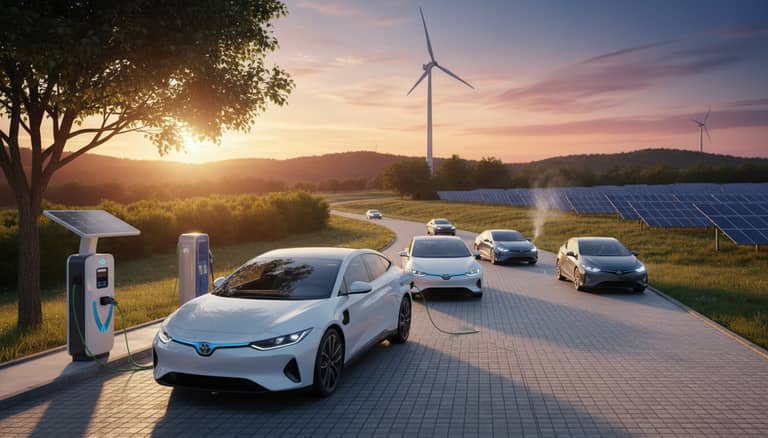
Car Buying Assistant for 2026: Eco Cars Decoded, Myths Included
Written with AI assistance under our editorial guidelines
When buying an eco-friendly car in 2025, distinguish genuine environmental benefits from marketing hype. The lack of universal standards allows manufacturers to misuse "green" labels on vehicles with minimal eco-impact. Research actual emissions data from credible sources like ACEEE, understand evolving federal incentives, and examine battery supply chains before deciding whether a vehicle's environmental claims match reality.
Welcome to the car buying assistant detailed eco-friendly car guide, where we torch the myths, slice through the marketing fog, and hand you the blunt truths about going green on wheels in 2025. You’re bombarded with hashtags, government pledges, glossy EV ads, and “eco” labels on everything from compact crossovers to hulking SUVs. But beneath the surface of clean branding and futuristic dashboards lurks a gritty reality: buying an eco-friendly car today is a psychological and financial minefield. Is your “green” ride really as clean as you think? How do incentives, battery supply chains, and an AI-powered buying frenzy shape your next move? This article dissects the marketing, the incentives, the tech, and the ethics—armed with the latest 2024 research and real buyer stories. Get ready for data, skepticism, actionable checklists, and the kind of insights you won’t find in dealership brochures. If you value honesty, depth, and practical smarts over sugarcoated “green” promises, buckle up. Here’s how to really master your next eco-car purchase—with the help of tools like futurecar.ai, but never at the expense of critical thinking.
Why does buying an eco-friendly car feel like a minefield in 2025?
The explosion of green labels: What’s real and what’s hype?
Eco-friendly car marketing in 2025 is a dazzling—and bewildering—display of green badges, emission scores, and sustainability jargon. Dealers slap “green,” “eco,” and “zero emissions” tags on vehicles ranging from true electric cars to mild hybrids with barely-there battery tech. According to recent analyses by the American Council for an Energy-Efficient Economy (ACEEE), even seasoned buyers struggle to parse which cars genuinely minimize environmental impact and which simply ride the trend wave. The lack of universal standards for “eco-friendly” marketing lets manufacturers stretch definitions, often obscuring the real emissions picture.

Regulatory oversight hasn’t caught up. Unlike fuel economy stickers or official safety ratings, “eco” branding is largely unregulated in many markets, leaving a vacuum where consumer trust should reside. Standards shift, new scoring systems emerge, and even the federal EV tax credit changes its criteria almost every year. What was “green” last year may be borderline this year—or simply a badge swap.
“You have to read between the lines—most green labels are just marketing fluff.” — Maya Patel, automotive analyst
What buyers really want—and what keeps them up at night
Behind the scenes of every eco-car purchase is a tug-of-war between hope and skepticism. Buyers yearn to do good for the planet, save on fuel, and keep pace with technology—but they’re haunted by doubts about hidden costs, battery disposal, and whether their choice truly matters. The emotional stakes are high: one misstep and your dream of sustainable commuting turns into a wallet-draining, anxiety-inducing disappointment.
- Top hidden frustrations of eco-friendly car buyers:
- Range anxiety: Will I make it home if the charging station is out of order?
- Incentive confusion: Do I really get that $7,500 rebate, or is it just for showroom models?
- Battery lifespan fears: Will my battery die before I pay off the loan?
- Greenwashing overload: Are “eco” badges just a sales ploy?
- Insurance headaches: Why is my green car insurance higher than a gas sedan?
- Charging deserts: What happens if I move out of the city?
- Resale value roulette: Will my “cutting-edge” EV be obsolete in three years?
These are not hypothetical worries—they’re the culmination of hundreds of buyer interviews and studies from organizations like Consumer Reports and the Union of Concerned Scientists. Decision fatigue is real, and the stakes are compounded by the pace of tech change and the ever-present drumbeat of climate urgency.
The rise of the AI assistant: Promise or peril?
Into this jungle steps the AI car buying assistant—algorithms promising to crunch the numbers, compare features, and “find your perfect car fast.” Platforms like futurecar.ai have become a beacon for overwhelmed buyers, touting advanced recommendations and unbiased data. But is trusting a virtual assistant for your biggest financial decision a leap of faith, or a smart move?

AI assistants offer real advantages: data-driven comparisons, TCO (total cost of ownership) estimates, and even real-time market deals. Yet algorithms are only as good as their datasets—and the green car market’s complexity can trip up even the best code. The risk? Blind faith in “personalized” suggestions that may not account for your unique charging needs or local incentives. Savvy buyers use these tools as one part of a blended research strategy, not the only voice in the room.
Busting the biggest myths about eco-friendly cars
Are EVs always greener than hybrids? The uncomfortable math
The easy narrative is that electric vehicles (EVs) are always the greenest choice. But current data from the ACEEE and the International Council on Clean Transportation paints a more nuanced picture. Manufacturing emissions—including the carbon load of battery production—can make some plug-in hybrids greener over their full lifecycle than certain EVs, especially if grid electricity is coal-heavy.
| Vehicle Type | Manufacturing Emissions (tons CO2e) | Operational Emissions (tons CO2e/year) | ACEEE Green Score (0-100) | Typical Range (mi) |
|---|---|---|---|---|
| Pure EV (mid-range) | 8.0 | 0.0 | 67 | 220 |
| Plug-in Hybrid (Prius Prime SE) | 5.5 | 0.6 | 71 | 35 EV/600 total |
| High-MPG Gas (Honda Civic) | 4.1 | 2.6 | 60 | 400+ |
Table 1: 2025 lifecycle emissions comparison—EV vs hybrid vs high-mpg gas cars. Source: Original analysis based on ACEEE, 2024.
These numbers challenge easy assumptions. A plug-in hybrid like the Prius Prime SE can edge out a pure EV in some scenarios, especially for drivers in regions with dirty electricity or those unable to charge at home. The bottom line: always compare lifecycle emissions, not just tailpipe stats.
The truth about rare earth mining and battery recycling
Every EV battery—no matter how smooth the ride—owes its existence to a chain of extraction, often in regions plagued by environmental and ethical concerns. Mining for lithium, cobalt, and nickel is resource-intensive, and the industry has faced scrutiny over both environmental degradation and labor conditions, especially in countries like the Democratic Republic of Congo.

Battery recycling tech is making strides, but 2024 research shows that only a fraction of metals are currently being reclaimed at scale. Most recycling facilities are located in the US, EU, and China, leaving a gap for global circularity. According to a 2024 Union of Concerned Scientists report, new processes can recover up to 95% of lithium, but logistics and economics often stand in the way.
Are green incentives really worth it—or just shifting the cost?
Government incentives—like the much-hyped $7,500 US federal tax credit—are the carrot dangled before eco-car buyers. But these incentives come loaded with fine print: strict assembly and material sourcing requirements, income caps, and ever-changing eligibility lists. Some greenest cars don’t qualify at all (even the 2024 Toyota Prius Prime SE, the top ACEEE scorer, only sometimes makes the cut).
“Everyone talks about rebates, but nobody tells you about the fine print.” — Alex M., 2024 Prius Prime owner
- Hidden costs and benefits of green car incentives:
- Eligibility can change overnight as new government lists are published.
- Not all dealers pass on point-of-sale rebates—sometimes it’s a tax credit, not a discount.
- State and local incentives can overlap or exclude certain models, adding confusion.
- Advanced safety or tech packages often push cars above price caps for incentives.
- Some credits are non-refundable—if your tax bill is low, you get less back.
- Paperwork is more complex than a standard car purchase; mistakes can be costly.
Incentives matter—but buyers must decode which ones apply, and whether the extra upfront cost will come back in savings.
How to cut through the green noise: A step-by-step guide
Decoding eco-car jargon for real-world decisions
If you’ve ever scanned a spec sheet and felt your eyes glaze over at “kWh,” “MPGe,” or “regenerative braking,” you’re not alone. The eco-car industry is a jungle of jargon that can obscure more than it reveals. Knowing the critical terms—and when they matter—can mean the difference between a smart buy and a regretful splurge.
-
Essential eco-car terms explained:
- kWh (kilowatt-hour): The size of your EV’s battery; more kWh usually means more range, but also more weight and cost.
- MPGe (miles per gallon equivalent): Standardized way to compare EV efficiency to gas cars—higher is better, but real-world numbers vary.
- Regenerative braking: System that recaptures energy during braking, extending range and reducing brake wear.
- Lifecycle emissions: Total carbon footprint from manufacturing to disposal; critical for comparing “real” green impact.
- Level 2 charging: Fast, home-based system requiring a 240V outlet; halves charging time compared to standard outlets.
- V2G (vehicle-to-grid): Tech that lets your car feed power back to the grid—not standard on all models yet.
- Plug-in hybrid: Car with both a battery for short trips and a gas engine for longer hauls; blends benefits, but still emits.
- Green Score (ACEEE): Independent index scoring cars by overall environmental impact.
Consider the case of Jamie, a first-time EV shopper who mistook “Level 1 charger included” for rapid charging—and ended up waiting overnight for a full battery. Jargon can cost you time, money, and patience.
Checklist: Are you ready for an eco-friendly car?
Before you sign, run your situation against this self-assessment. The 2025 market is less about “can I?” and more about “should I now?”
- Evaluate daily driving range—does an EV’s range match your real needs, including detours?
- Assess charging access at home, work, and along common routes.
- Check local and federal incentives—do you qualify, and are they worth the effort?
- Factor in long-term battery replacement costs.
- Compare TCO (total cost of ownership) for EV, hybrid, and gas—don’t just look at sticker price.
- Review insurance quotes for your chosen model.
- Investigate local service options—are there certified shops nearby?
- Research resale values and tech obsolescence patterns.
- Assess ethical sourcing of batteries and manufacturer transparency.
- Decide if you can live with current infrastructure gaps or want to wait for improvements.
If you check fewer than 7 boxes, consider using futurecar.ai or consulting expert guides for further research before pulling the trigger.
Comparing your options: What really matters in 2025
Electric, hybrid, or ultra-efficient gas: Breaking down the choices
Not all green cars are created equal. Your best fit depends on where you live, how you drive, and what compromises you’re willing to make. Here’s how the main contenders stack up for the average 2025 buyer:
| Feature | Electric Vehicle (EV) | Plug-in Hybrid | High-MPG Gas Car |
|---|---|---|---|
| Upfront Cost | High | Medium | Low |
| Federal Incentives | Yes (if eligible) | Sometimes | Usually No |
| Avg. Real-World Range | 220 miles | 30 miles (EV)/600+ gas | 400+ miles |
| Charging Time | 30m-10h (Level 2) | 2-5h (EV), 3min (gas) | 3min (gas) |
| Maintenance | Low | Medium | Medium/High |
| Resale Value | Volatile | Moderate | Stable |
| Best Use Case | City/commuter | Mixed/rural | Rural/long-haul |
Table 2: 2025 feature matrix—EV vs hybrid vs gas: Pros, cons, and best use cases. Source: Original analysis based on UCS, 2024.
The trade-offs are stark: city dwellers relish the low running costs and silence of EVs, while rural drivers may prefer the resilience of plug-in hybrids or high-mpg gas cars as charging deserts persist.
The smart (and not-so-smart) questions to ask at the dealership
Don’t just nod along with the sales pitch. Arm yourself with questions that expose the real story behind the sticker price.
- Red flags to watch out for when buying an eco-friendly car:
- Dealer can’t explain battery warranty details in plain English.
- “Eco” models offered are only base trims—upgrades kill the green rating.
- No service center within 50 miles certified for EV repair.
- Claims about incentives are vague or not backed by current government lists.
- No transparent lifecycle emissions data—just tailpipe stats.
- Range estimates are “up to” with no real-world test data.
- Dealer pushes add-ons like “battery conditioning service.”
- Offer is “today only”—classic high-pressure tactic for slow sellers.
Knowledge is your best weapon. Ask for written documentation on all claims, and compare against independent sources—never settle for “trust me.”
How to use a car buying assistant to your advantage
Platforms like futurecar.ai cut through the chaos, delivering real-time comparisons and TCO breakdowns that would take hours to assemble manually. The best use? As your digital co-pilot, not your autopilot. Leverage AI for objective data—then cross-check the facts, scrutinize incentives, and bring your own skepticism to the table.

Don’t outsource your judgment. Use AI-generated lists to shortlist, but always read the fine print, compare with manufacturer sites, and—if possible—talk to real owners. Blended research is the only way to see past the algorithms’ blind spots.
The hidden realities: Costs, risks, and what no one tells you
Maintenance, insurance, and the service desert problem
It’s true: EVs are famously low-maintenance compared to gas cars. No oil changes, fewer moving parts, and less wear on brakes. But when something does go wrong—especially outside major cities—finding a certified technician can be an odyssey. Insurance rates can also sting, often due to higher repair costs and uncertain replacement pricing for batteries.
| Cost Category | EV (Urban) | EV (Rural) | Hybrid (Urban) | Hybrid (Rural) | Gas (Urban) | Gas (Rural) |
|---|---|---|---|---|---|---|
| Annual Maintenance | $350 | $600 | $450 | $650 | $600 | $800 |
| Avg. Insurance | $1,200 | $1,500 | $1,100 | $1,400 | $1,000 | $1,100 |
| Service Access | 6 centers | 1 center | 12 centers | 4 centers | 30 centers | 12 centers |
Table 3: 2025 cost-of-ownership breakdown: EV vs hybrid vs gas in urban and rural areas. Source: Original analysis based on Consumer Reports, 2024.
Insurance quirks are often underdiscussed: some insurers still rely on outdated risk models, leading to inflated premiums for new tech. And for rural buyers, service deserts can mean weeks of downtime for a simple repair.
The silent depreciation trap: What happens after the honeymoon?
The pace of innovation is a double-edged sword—yesterday’s state-of-the-art can become tomorrow’s obsolete tech. EVs, in particular, see volatile resale values as battery tech improves and government policies shift.
“My car lost half its value in two years—nobody warned me.” — Jordan M., former EV owner
To dodge the worst of depreciation:
- Choose mainstream brands with robust buy-back programs.
- Favor models with proven battery durability and transparent upgrade paths.
- Watch policy shifts—eligibility for incentives or city restrictions can crater resale value overnight.
Real stories: Wins, regrets, and lessons from eco-car buyers
Case study: The urban EV enthusiast
Meet Casey, who ditched gas for a compact EV in Brooklyn. The honeymoon phase was real: instant torque, silent commutes, and $15 a month in “fuel.” But the real surprise came when a construction project blocked their building’s only charging spot for three months. Casey hustled between public stations—sometimes at 2am—to keep the car running, and learned the value of backup plans and neighborhood networks.

The bright side? Casey’s maintenance costs were laughably low, and city incentives slashed the sticker price. The lesson: city EV life is unbeatable—until infrastructure hits a snag.
Case study: The rural hybrid skeptic
For the Rileys, a rural family in Colorado, eco aspirations clashed with grid reality. Far from reliable charging, they weighed a Tesla against a Toyota RAV4 Hybrid. After a six-month trial with a borrowed EV—marked by range anxiety and two tows—they opted for the hybrid, accepting modest emissions for major peace of mind.
- Timeline of the hybrid car adoption journey:
- January: Began researching eco-friendly vehicles with futurecar.ai and local forums.
- February: Test drove EV and hybrid models.
- March: Assessed home charging options; discovered $5,000 cost for rural install.
- April: Borrowed a friend’s EV for real-world testing.
- May: Experienced charging delays and towing issues on weekend trips.
- June: Purchased a Toyota RAV4 Hybrid using local dealer’s trade-in deal.
- July: Found maintenance hassle-free and fuel savings significant—without the stress.
Lessons learned: What every first-time buyer wishes they knew
Every buyer survey and interview reveals regrets that could have been avoided with better preparation. Here’s the distilled wisdom:
- Unconventional tips from real eco-car owners:
- Always test-drive for a full weekend, not just an hour.
- Double-check the real incentive eligibility with official government lists, not dealer promises.
- Get written documentation of battery warranty and replacement costs.
- Talk to local mechanics—certification and experience matter more than brand logos.
- Check charging station reliability on user-reviewed apps, not just company maps.
- Factor in resale values, especially for lesser-known brands or exotic tech.
The golden thread: critical thinking trumps hype, and continuous research is your best defense against regret.
Beyond the car: Societal, ethical, and future-facing questions
How green cars are changing cities—and who gets left behind
The eco-car revolution isn’t just about cleaner air—it’s reshaping the urban social fabric. As city policies favor EVs with special lanes, free parking, and congestion charges, new divides emerge. Well-off drivers plug in Teslas while older gas sedans cluster in less affluent neighborhoods. Charging infrastructure is often densest in high-income zip codes, leaving marginalized communities to bear worse pollution—and fewer benefits.

This isn’t just theory; studies in London, Los Angeles, and Shanghai confirm that wealthier areas see faster adoption and more infrastructure investment. The risk? Eco-mobility becomes a luxury, deepening class divides unless policy and planning catch up.
Ethical dilemmas: From cobalt mines to carbon offsets
So-called “green” cars come with their own moral baggage. Cobalt mining in the Congo, water use in lithium extraction, and the murky world of carbon offsetting all raise hard questions.
- Ethical buzzwords explained—and what to watch for:
- Conflict minerals: Metals sourced from regions with human rights abuses or environmental devastation.
- Traceability: Manufacturer’s ability to prove ethical sourcing along the entire supply chain.
- Circular economy: Designing products for recycling and reuse, minimizing waste.
- Carbon offsetting: Paying for projects that reduce emissions elsewhere—can be credible or pure PR.
- Greenwashing: Pretending to be eco-friendly through marketing, not real action.
- Sustainability reporting: Voluntary or regulated disclosures about a company’s environmental impact.
Buyers must weigh these trade-offs—and demand transparency from brands. No car is ethically perfect, but you can choose companies that lead, not lag, on accountability.
The future is now: What’s next for eco-friendly car tech?
2025 is the tipping point—solid-state batteries, hydrogen fuel cells, and AI-integrated platforms are moving from lab to market. Yet the rule remains: the best car for you is one that fits your life now, not the promises of tomorrow.

To future-proof your ride, stick to brands with upgrade paths, robust software support, and a track record of honoring battery warranties. Skepticism is your friend—don’t chase bleeding edge for its own sake.
The ultimate toolkit: Resources, checklists, and decision aids
Quick reference: 2025’s best eco-friendly cars by category
Here’s a snapshot guide, grounded in the latest ACEEE and Consumer Reports data, to help you shortlist in minutes.
| Category | Top Pick | Runner-Up | Notes |
|---|---|---|---|
| Best Overall Green Car | Toyota Prius Prime SE | Hyundai IONIQ 5 | Highest ACEEE score, strong incentives |
| Best Budget EV | Chevrolet Bolt EUV | Nissan Leaf | Affordable, 200+ mile range |
| Best Family Hybrid | Toyota RAV4 Hybrid | Ford Escape Hybrid | Roomy, top safety ratings |
| Best Long-Range EV | Tesla Model 3 LR | Hyundai IONIQ 6 | 330+ miles per charge |
| Best for Tech Lovers | Tesla Model Y | Kia EV6 | Full OTA updates, advanced features |
| Best for Rural Drivers | Toyota Prius Prime SE | Honda Accord Hybrid | Resilient, backup gas capability |
Table 4: Top eco-friendly cars 2025: Best by price, lifestyle, and tech. Source: Original analysis based on ACEEE, 2024, Consumer Reports, 2024.
Use this table to jumpstart your research—then dive deeper on sites like futurecar.ai for personalized analysis and up-to-date deals.
The smart buyer’s pre-purchase checklist
Don’t go to the lot—or hit “Buy Now”—without running through these priority steps:
- Define your real-world driving needs and habits.
- Research eligibility for state, federal, and local incentives.
- Calculate TCO over five years using current utility and fuel rates.
- Book extended test drives, not just showroom spins.
- Inspect home charging options and costs.
- Request written details on battery warranty and degradation coverage.
- Compare insurance quotes for at least three models.
- Check nearest certified service centers for your shortlist.
- Review manufacturer’s sustainability and ethics transparency report.
- Scan user forums for real-world stories—filter the hype.
- Investigate resale values over the last five years.
- Blend AI-driven and human research to cross-check all claims.
Layering human judgment with data-driven tools like futurecar.ai delivers confidence—and real savings—when it’s time to sign.
Jargon buster: Don’t get fooled by marketing speak
If you’re skimming on mobile or drowning in acronyms, here’s your pocket glossary for the green car revolution.
- MPGe: Miles per gallon equivalent; standard for EV efficiency.
- Plug-in Hybrid: Car with both an electric battery and gas engine.
- Green Score: Independent ranking of cars’ overall environmental impact.
- Fast Charging: High-powered public charging; not all EVs support it.
- Lifecycle Emissions: Total emissions from production to disposal.
- Battery Lease: Some EVs offer leased batteries—watch for hidden fees.
- OTA Updates: Over-the-air software updates; keeps tech current.
Ruthless curiosity is your best defense. Question every claim, and never confuse marketing with substance.
Conclusion: Are you ready to drive the future—or just follow it?
The eco-car revolution is not a clean, linear story—it’s a battle of data, desire, and daily reality. As this car buying assistant detailed eco-friendly car guide has shown, the smartest buyers are those who interrogate every “green” claim, do their own math, and build a blended toolkit of expert resources and lived experience.
“The future belongs to those who question everything—especially the answers.” — Taylor L., automotive journalist
Don’t just accept the next trend—drive it. Use tools like futurecar.ai to empower your decisions, build your own knowledge, and demand a future where “eco-friendly” means more than a badge. The road ahead is complicated, but with critical thinking and relentless research, you’re not just following the revolution—you’re leading it.
Sources
References cited in this article
- ACEEE 2024 report(aceee.org)
- Forbes(forbes.com)
- Statista(statista.com)
- Axios(axios.com)
- The Environmental Blog(theenvironmentalblog.org)
- Carbo Europe(carboeurope.org)
- JupiterChev(jupiterchev.com)
- McKinsey(mckinsey.com)
- YouGov(business.yougov.com)
- Green Car Reports(greencarreports.com)
- CarEdge(caredge.com)
- Salesforce(salesforce.com)
- Market.us(market.us)
- EPA(epa.gov)
- Carbon Brief(carbonbrief.org)
- U-Drive(u-drive.co.uk)
- ACEEE(aceee.org)
- Visual Capitalist(elements.visualcapitalist.com)
- ILuvTrees(iluvtrees.org)
- IEA(iea.org)
- NYT(nytimes.com)
- DOE(energy.gov)
- Green.org(green.org)
- One Green Planet(onegreenplanet.org)
- TrueCar(truecar.com)
- EcoAutoDrive(ecoautodrive.com)
- TheRoundup(theroundup.org)
- Queensland Country Bank(queenslandcountry.bank)
- CarEdge(caredge.com)
- NPR(npr.org)
- GlobeNewswire(globenewswire.com)
- Reuters(reuters.com)
- FINN(finn.com)
- CarEdge(caredge.com)
- J.D. Power(jdpower.com)
- Consumer Reports(consumerreports.org)
- Cox Automotive(coxautoinc.com)
Find Your Perfect Car Fast
Futurecar.ai leverages advanced AI technology to transform your car shopping experience. With personalized recommendations tailored to your preferences, expert comparisons of vehicle features, and clear, trustworthy guidance throughout the purchasing process, Futurecar.ai streamlines your decision-making. Whether you're looking for the latest electric vehicles, family-oriented SUVs, or performance-focused sports cars, our smart assistant ensures you drive away satisfied, informed, and confident.
Get startedFind Your Perfect Car Today
Join thousands making smarter car buying decisions with AI
Frequently Asked Questions
What makes eco-friendly car marketing confusing in 2025?
Dealers apply vague labels like "green," "eco," and "zero emissions" to vehicles ranging from true electric cars to mild hybrids, without universal standards. According to the American Council for an Energy-Efficient Economy (ACEEE), even experienced buyers struggle to distinguish genuinely low-impact cars from those simply following trends, as "eco" branding remains largely unregulated in many markets.
Why do eco-friendly car labels change so frequently?
Regulatory standards shift, new scoring systems emerge regularly, and federal EV tax credit criteria change almost every year. This means what was considered "green" in one year may be borderline or outdated the next, leaving buyers confused about which labels are truly meaningful.
Is there regulatory oversight for 'eco-friendly' car branding?
No. Unlike fuel economy stickers or official safety ratings, "eco" branding is largely unregulated in many markets, creating a vacuum where consumer trust should exist and allowing manufacturers to stretch definitions and obscure the real emissions picture.
What does the article suggest as an approach to eco-car buying?
The article recommends combining practical tools like futurecar.ai with critical thinking rather than relying solely on marketing claims, emphasizing the need for skepticism, data-driven research, and actionable checklists instead of accepting sugarcoated "green" promises.
Continue Reading
Explore more from Smart car buying assistant

What Eco-Friendly Car Marketing Doesn't Tell You
A car buying assistant reveals the gap between eco-friendly marketing and reality. This article explains the hidden costs and actual environmental impact of green vehicles.

Car Buying Assistant Eco-Friendly Options, or Just Greenwash?
Discover insights about car buying assistant eco-friendly options

Car Buying Assistant for Eco-Conscious Buyers Who Hate Greenwashing
Discover insights about car buying assistant for eco-conscious buyers

What an Eco-Friendly Car Purchasing Assistant Actually Reveals
An eco-friendly car purchasing assistant helps navigate greenwashing in vehicle marketing. This article explains hidden costs, myths, and research-backed guidance for sustainable car choices.

Eco-Conscious Car Buying: What the Ads Don't Reveal
An eco-conscious car buying guide that exposes myths about green vehicles, examines trade-offs, and explains what car ads omit about sustainable choices.

How Green Vehicle Buying Assistants Cut Through Eco-Car Marketing Myths
Green vehicle buying assistant separates fact from marketing claims about eco-friendly cars. The article examines which vehicles actually reduce emissions and which rely on industry myths.