Car Buying Out-The-Door Price Decoded to Beat Dealer Games
Written with AI assistance under our editorial guidelines
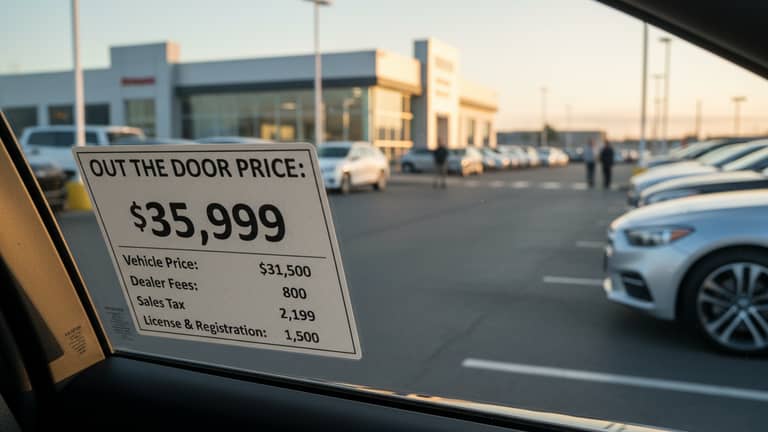
The out-the-door price is the total amount you pay for a car, including the negotiated sale price, state taxes, registration fees, dealer documentation charges, and add-ons like warranties and paint protection. Understanding this full calculation helps buyers avoid dealer tactics that exploit confusion by layering costs until the final number far exceeds the advertised sticker price.
There’s a moment—somewhere between the thrill of picking a new car and the dull ache of signing the paperwork—where reality hits. You stare at the final number: the out-the-door (OTD) price. It’s the sum that stands between you and your new ride, and it’s almost always higher than you dared imagine. Forget the seductive sticker on the windshield. That’s just Act One. The real drama unfolds in the back offices, where fees multiply, extras materialize, and the line between a good deal and a sucker punch blurs. In 2025, with new car prices still hovering near historic highs—averaging $48,600 to $48,700 according to recent data—and used vehicles stubbornly clinging to $25,100–$25,700, understanding the out-the-door price isn’t just smart; it’s survival. Dealers bank on confusion, layering costs until buyers are too exhausted to fight back. This isn’t just a guide. It’s your arsenal for decoding the industry’s most misunderstood number. Let’s tear down the façade and expose what you’re really paying for.
The real meaning of out-the-door price
Why the sticker price is just the beginning
If you’re fixated on the number pasted to the car window, you’re already playing the dealer’s game. The sticker (or MSRP) is a starting point, not a finish line. The true price of a car in 2025 is a patchwork of state taxes, dealer fees, documentation charges, and “must-have” add-ons—each one expertly engineered to seem both inevitable and invisible. The out-the-door price, by contrast, is the full freight: every penny you’ll pay to take those keys and drive away.

Here’s what defines the out-the-door price in plain English:
The manufacturer’s suggested retail price; the number that gets you in the door, rarely what you’ll actually pay.
The negotiated price before fees, incentives, or add-ons—could be below or above MSRP.
State sales tax (ranging from 0–9.5% in the U.S.), title fees, and registration costs.
Documentation (“doc”) fees, processing fees, and any other mandatory charges from the dealership.
Products like paint protection, VIN etching, and extended warranties; often pushed at signing.
The sum total of all the above—the only number that matters.
Breaking down every line item
Car buyers in 2025 are facing an average OTD price that often dwarfs the initial offer by thousands. Let’s lay out a sample out-the-door calculation for a new vehicle:
| Item | Example Cost (USD) | Notes |
|---|---|---|
| Sticker Price (MSRP) | $40,000 | Manufacturer’s base price |
| Negotiated Sale Price | $38,500 | After dealer discounts |
| Sales Tax (7%) | $2,695 | Varies by state |
| Registration & Title | $350 | Government fees |
| Documentation Fee | $499 | Dealer processing |
| Dealer Add-ons | $800 | Paint, VIN etch, etc. |
| Total OTD Price | $42,844 | The “real” price you pay |
Table 1: Typical out-the-door price breakdown for a new car purchase.
Source: [Original analysis based on Edmunds, Bankrate, CarEdge]
According to Edmunds, the out-the-door price “is the grand total you pay to walk out with the keys in hand.” This number often includes stealthy line items that stay hidden until the very end. Understanding each component is the first step toward reclaiming your bargaining power.
How dealerships define 'out-the-door' (and why it matters)
The catch? Not every dealership plays by the same rules. Some advertise an “OTD price” that omits key fees or applies only if you use their financing. According to Bankrate, “Out-the-door price is the entire cost including fees and sales tax, differing from MSRP.”
“The out-the-door price is the only number you need to focus on. Ignore everything else. Dealers love to play shell games with fees—don’t let them.”
— Edmunds Car Buying Guide, 2024
When you demand the OTD price in writing, you’re forcing transparency into a process built on misdirection. It’s your weapon against upcharges and last-minute surprises, and in today’s market, it’s non-negotiable.
The hidden world of car dealer fees
Junk fees, must-haves, and the fee hall of shame
Dealer fees are the automotive industry’s dirty little secret. Some are legit; others are pure profit masquerading as “requirements.” Knowing the difference is your best defense.
- Documentation (“doc”) fees: Ostensibly cover paperwork processing, but can range from $80 to $900 depending on the state. In some regions, these are capped by law; in others, they’re at the dealer’s discretion.
- Dealer prep fees: Purportedly for prepping the car, but often double-charged (manufacturers usually pay for this).
- Destination charges: Legitimate, but non-negotiable—typically $900 to $1,500.
- Advertising fees: Dealers pass along local ad costs, but these are sometimes negotiable.
- VIN etching, nitrogen tires, paint protection: High-margin add-ons often bundled with little real value.
- Market adjustment fees: Dealers charge above MSRP due to high demand—completely discretionary.

If you see a fee you don’t understand, ask for an explanation and challenge it. According to CarEdge, “Dealer fees can sometimes add thousands to the final bill, many of which are avoidable or negotiable.”
Regional quirks: Why your OTD price is different in every zip code
Dealer fees and taxes aren’t just dealer-driven—they’re shaped by geography. Here’s a snapshot of how dramatically costs can differ:
| Region | Doc Fee Range | Sales Tax (%) | Add-on Prevalence | Notable Quirk |
|---|---|---|---|---|
| California | $80–$85 | 7.25–10.5 | High | Highest emissions/testing fees |
| Florida | $500–$900 | 6–7 | Moderate | Sky-high documentation fees |
| New York | $75–$175 | 4–8.875 | Medium | Multiple registration surcharges |
| Texas | $150–$300 | 6.25 | High | Frequent market adjustment markups |
| Illinois | $303–$347 | 7.25–10.25 | High | “Dealer services” fees not capped |
Table 2: Regional variations in OTD component costs in 2025.
Source: Original analysis based on CarEdge, 2025 and Motor Hills, 2025
Even if you’re buying the same make and model, your location—down to the zip code—directly impacts your OTD price. Always check local regulations and fee caps before you buy.
Are any add-ons actually worth it?
Not every extra is a rip-off—but most are. Here’s how the most common ones stack up:
- Extended warranties: Sometimes valuable for high-tech or luxury models, but often overlap with manufacturer coverage.
- Gap insurance: Worth considering if you’re heavily financing or putting little down.
- Paint and fabric protection: Rarely cost-effective; DIY options are cheaper and just as good.
- VIN etching: Inexpensive at the DMV—dealers charge a premium.
- Tire and wheel insurance: Only worth it for drivers in rough-weather or pothole-prone areas.
The general rule? If a product is being pushed hard in the F&I (finance and insurance) office, it’s probably high-profit and low-value for you. According to Investopedia, 2025, “Buyers should be skeptical of any add-on that isn’t clearly explained and itemized.”
Negotiation: Turning the tables on the dealership
How to demand real transparency (and not get ghosted)
Transparency isn’t just an ethical ideal—it’s your leverage. The best negotiators know to cut through the noise and demand a written OTD quote before stepping foot in the dealership.
“Ask for the OTD price in writing before you show up. If a dealer dodges or delays, walk away—there’s always another lot.”
— Autolist, 2024
The key is to insist on an email or text confirmation. Dealers are far less likely to play games when there’s a paper trail. This shifts power to you, exposing hidden fees before you’re deep into the buying process.
After you get the OTD price in writing, cross-check every item—line by line. If the numbers change between email and the finance office, you know you’re not dealing with a straight shooter.
Step-by-step: Getting your OTD price in writing
- Research target vehicles and average OTD prices using resources like futurecar.ai for recent market data.
- Contact multiple dealers online, requesting their best OTD price for your configured vehicle.
- Specify the terms: Clearly ask for a detailed breakdown of all fees, add-ons, and taxes.
- Insist on written documentation of the OTD quote—email is best, but text works too.
- Compare offers side-by-side, highlighting any unusual or excessive charges.
- Leverage competing quotes to negotiate out unnecessary fees.
- Confirm the OTD price before visiting the dealership—and bring a copy with you.
Getting the OTD price in writing isn’t just smart; it’s essential protection in a high-stakes financial transaction. Every step is a layer of armor against unexpected costs.

What dealers hope you never ask
There’s a reason dealers keep the OTD calculation vague until the last possible moment: it’s their best shot at boosting profit. Here are the questions they hope you skip:
- What is your total out-the-door price, including all taxes and fees, if I pay cash?
- Which dealer-installed options are mandatory, and which are optional?
- Can you send me the full price breakdown in writing before I visit?
- Are there any add-ons or services included that I did not request?
- What incentives or discounts am I eligible for—and are they already applied?
- What’s the APR if I choose your financing, and how does it change the OTD price?
Dealers rely on information asymmetry. Asking these questions tips the scales in your favor and signals you’re not an easy mark.
Case studies: The OTD price rollercoaster
Jordan’s story: Out-the-door shock on a used car
Jordan thought he’d nailed a deal: a two-year-old sedan listed at $22,000. The sales rep was friendly—until the finance manager appeared. Suddenly, that “great price” ballooned to $26,100. Here’s the breakdown:
| Item | Cost | Surprise? |
|---|---|---|
| Listed Price | $22,000 | No |
| Sales Tax (7.5%) | $1,650 | Expected |
| Documentation Fee | $750 | High |
| Dealer Add-ons (paint, VIN) | $800 | Pushed at signing |
| Non-optional prep fee | $400 | New to buyer |
| Registration | $500 | Standard |
| Total OTD Price | $26,100 | Sticker shock |
Table 3: Real-world used car OTD breakdown—what looked like a deal turned costly.
Source: Original analysis based on aggregated consumer reports and CarEdge, 2025
“They kept saying ‘everyone pays these fees.’ By the time I sat in the finance office, I was too tired to fight back. I signed—and regretted it for weeks.”
— Jordan (Consumer anecdote, 2025)

Jordan’s story isn’t unique. According to Motor Hills, 2025, “Almost half of buyers report paying $1,000 or more in fees they didn’t anticipate.”
Chris’s play-by-play: Negotiating a new EV in 2025
Chris approached the dealership with a plan—armed with OTD quotes and competition on speed dial. Here’s how the negotiation unfolded:
- Chris researched average OTD prices for his preferred EV model using online comparison tools and forums.
- He requested OTD quotes from four dealerships, specifying no add-ons and full breakdowns.
- One dealer undercut the others by $800—but included a $1,200 “market adjustment fee.”
- Chris called out the fee, citing lower competitor offers and threatening to walk.
- Dealer dropped the adjustment, shaved $300 off the doc fee, and included free registration.
- Chris confirmed the adjusted OTD price in writing, then closed the deal—saving $1,500 versus initial offers.

Chris’s story proves that preparation—and a willingness to walk—can flip the script. In 2025, even with tight EV supply, OTD price transparency is your best friend.
Debunking myths about out-the-door price
Myth vs. reality: The five biggest misconceptions
The car-buying world is full of half-truths and urban legends. Let’s clear the air:
- Myth: The sticker price is what you’ll pay.
Reality: Hidden fees and add-ons can add thousands. - Myth: Dealer fees are non-negotiable.
Reality: Many are padded or redundant—challenge them. - Myth: The OTD price is always the best price you can get.
Reality: It’s a starting point for negotiations, not the end. - Myth: All buyers pay the same OTD price.
Reality: Zip code, timing, and negotiation skills cause huge variances. - Myth: Financing doesn’t impact OTD price.
Reality: Dealer-arranged loans can include rate markups and extra fees.

Challenging these myths isn’t just smart—it’s necessary if you want to avoid paying the “sucker tax.”
Is OTD price really the cheapest you can pay?
The total, all-inclusive payment needed to take ownership of the vehicle, including all mandatory costs.
The price after discounts before taxes and fees—sometimes misleadingly advertised.
Synonymous with OTD in some regions, but check for hidden exclusions.
Paying the OTD price doesn’t always mean you’ve gotten the best deal—especially if you haven’t scrutinized every fee. According to Edmunds, 2024, “Savvy buyers can often negotiate a lower OTD price by eliminating unnecessary add-ons and haggling over dealer fees.”
A true “lowest” OTD price is only possible if you question everything—don’t be afraid to walk if the numbers don’t add up.
The legal lowdown: What’s actually required by law?
Dealers are required to disclose certain costs by federal and state law, but plenty of grey zones remain. Here’s what’s typically mandated:
| Fee/Charge | Disclosure Required? | Negotiable? | Notes |
|---|---|---|---|
| State Sales Tax | Yes | No | Set by law |
| Registration/Title | Yes | No | Official state fees |
| Documentation Fee | Yes | Sometimes | Capped in some states |
| Add-ons | Yes (if included) | Yes | Only if buyer agrees |
| Market Adjustment | No | Yes | Fully discretionary |
Table 4: Legal requirements for car dealer fee disclosure in the U.S., 2025.
Source: Original analysis based on Bankrate, 2025
Understanding your rights isn’t just good form—it’s the best way to avoid “fee creep” and demand a fair shake.
The digital disruption: AI, apps, and the new price transparency
How smart tools are shifting power to buyers
Welcome to the age where information is the ultimate equalizer. AI-powered platforms and price transparency apps are bulldozing the old games, letting buyers compare OTD prices in real time, spot hidden fees, and even decode dealer incentives.

“Digital tools have dramatically increased buyer leverage. Those who use OTD calculators and price aggregators routinely save hundreds—or more.”
— Investopedia, 2025
Armed with AI-driven market data, buyers aren’t just informed—they’re in control.
Using futurecar.ai to cut through the noise
Platforms like futurecar.ai streamline the car-buying process by providing real-world OTD price data, expert guidance, and side-by-side comparisons of vehicles and fees. Here’s how to leverage them:
- Enter your preferences for make/model, budget, and location.
- Review tailored vehicle recommendations with transparent OTD pricing, factoring in local taxes and fees.
- Compare multiple vehicles at once, seeing a true apples-to-apples OTD cost.
- Get tips on negotiation and red flags sourced from real-time buyer feedback.
- Access AI-powered advice that updates as market conditions shift.
Using these tools means fewer surprises, better deals, and a car-buying experience that feels more like shopping—and less like running a gauntlet.
In a world awash with data (and misinformation), futurecar.ai helps buyers see through the haze and focus on the only number that matters: the real OTD price.
The risks of relying on tech alone
But beware: technology is a tool, not a guarantee. Apps and AI can provide data, but they can’t negotiate for you or smell out every trick.
- Incomplete data: Some platforms rely on dealer-provided info—which can be outdated or selective.
- Regional differences: Tech can miss local fees, taxes, or unique dealer tactics.
- Emotional factors: No algorithm can gauge a salesperson’s willingness to deal, or your own ability to walk away.
- Over-reliance: Blindly trusting the first OTD quote from any tool is risky—always verify.
Even the best digital assistant can’t replace a sharp, skeptical buyer. Use tech as a flashlight, not a crutch.
Practical checklists and takeaways
OTD price negotiation checklist
- Research your target vehicle’s OTD price—use multiple sources for benchmarks.
- Request detailed OTD quotes from at least three dealers, in writing.
- Scrutinize every fee—ask for justification or deletion of anything that looks suspicious.
- Refuse unnecessary add-ons—say no to extras you didn’t request.
- Confirm incentives are applied—double-check discounts and rebates.
- Bring your own financing offer—compare against dealer-provided rates.
- Get the final OTD price in writing—never rely on verbal promises.
- Be ready to walk if numbers change at signing.
Negotiating the OTD price isn’t about being confrontational—it’s about protecting your financial future.

Red flags to watch for before you sign
- Last-minute fees added at signing (“we forgot to mention…”)
- Mandatory dealer add-ons you never requested
- Vague explanations of fees (“every dealer charges this”)
- Pressure to use dealer financing for the “best” price
- “This offer is only good today” sales tactics
- Refusal to provide written itemization of the OTD price
- Confusing math or unexplained discrepancies between quotes and contracts
If any of these red flags appear, hit pause and demand answers—or walk away.
Questions every buyer should ask (but almost nobody does)
- Can you show me a full breakdown of the OTD price, line by line?
- Which fees are required by state law, and which are dealer discretion?
- Are there any incentives or rebates I’m missing?
- Is there a penalty for paying cash instead of financing?
- What’s the return or cancellation policy if I change my mind?
- Can you match or beat a competitor’s OTD price?
Asking tough questions won’t win you popularity points—but it will save you serious money.
Expert insights: What pros wish you knew
Dealer confessions: Tricks of the trade
Most salespeople won’t admit it, but behind closed doors, they know the OTD game is stacked.
“We count on buyers focusing on the monthly payment, not the OTD price. The more tired they get, the more fees slip through.”
— Former dealership finance manager, anonymous interview, 2024

The lesson: keep your eye on the only number that counts.
Consumer advocates on beating the system
Consumer watchdogs agree—preparation and skepticism are your best friends.
“Never assume any fee is required just because it appears on a form. Question everything and get it in writing.”
— CarEdge Guide, 2025
Most buyers overpay because they’re intimidated or exhausted. Arm yourself with knowledge, and you flip the power dynamic.
Staying vigilant through the process isn’t just a money-saver; it’s the only way to avoid buyer’s remorse.
The future of car buying out-the-door pricing
Will true transparency ever arrive?
The promise of a fully transparent car-buying experience is still a work in progress. Marketplaces and new AI platforms are making inroads, but as long as dealerships control the paperwork, “surprise” fees will persist. Today’s buyer, however, has more tools and leverage than ever.

The single best antidote to industry gamesmanship is relentless curiosity. Challenge assumptions, demand proof, and don’t buy the hype.
How to stay ahead of the next wave of changes
- Keep using comparison tools like futurecar.ai to benchmark OTD prices.
- Follow local fee and tax updates—these change often and impact your bottom line.
- Network with other buyers online for fresh dealer insights and fee trends.
- Check for seasonal incentives—holiday and model-year-end deals can mean big savings.
- Document every offer in writing; screenshots are your friend.
- Stay flexible on make/model if OTD prices climb beyond your budget.
Staying proactive means you’re never caught flat-footed—no matter how the market shifts.
Being your own best advocate is easier than ever, but only if you combine digital intelligence with that old-school skepticism.
Final thoughts: Becoming your own best advocate
Understanding the out-the-door price isn’t just about saving money—it’s about seizing control in a system designed for confusion. In 2025, with cars more expensive and fees more creative than ever, knowledge is your only shield. Demand transparency, double-check every number, and never sign until you’re sure what you’re paying for. The tools—digital and otherwise—are in your hands. The rest is up to you.
The next time you walk into a dealership, do it with your eyes open and your questions ready. In the car game, the real win is knowing exactly what you paid for—and why.
Key Statistics & Facts
- Average new car price (2025): $48,600–$48,700 (slightly down from 2022 peak, still near record highs).
- Average used car price (2025): $25,100–$25,700 (about half the new car price, still historically high).
- Hidden costs: Steep depreciation (30–40% loss in first 3 years), high financing rates (used car loans ~14% APR), taxes, dealer fees, and add-ons.
- Trends: Slight new car price declines or stabilization; used car prices remain firm due to tight supply. EV prices dropping faster due to incentives.
- Monthly payments: For many buyers, comparable to mortgage payments.
- Negative equity: Growing risk due to longer loan terms.
- Expert advice: Use dealer invoice pricing tools, shop during holiday/model-year-end clearances. Sources:
- CarEdge: New or Used Car 2025
- Investopedia: 2025 Trends
- Motor Hills: 2025 Market Analysis
- OTD price: The total, all-inclusive amount a buyer pays to take possession of the car, including the sale price, taxes, fees, registration, documentation, and mandatory dealer charges.
- Why it matters: Prevents surprises, enables accurate budgeting and negotiation.
- Edmunds: "The out-the-door price is the grand total you pay to walk out with the keys in hand."
- Bankrate: "OTD price is the entire cost including fees and sales tax, differing from MSRP."
- Edmunds
- Bankrate
- Autolist
Below is a structured, comprehensive summary of current research on car buying out-the-door (OTD) price, covering statistics, expert opinions, regulatory changes, negotiation strategies, myths, and real-world examples for 2024–2025.
1. Car Buying Out-the-Door Price: Exposing the Hidden Costs in 2025
Key Statistics & Facts
- Average new car price (2025): $48,600–$48,700 (slightly down from 2022 peak, still near record highs).
- Average used car price (2025): $25,100–$25,700 (about half the new car price, still historically high).
- Hidden costs: Steep depreciation (30–40% loss in first 3 years), high financing rates (used car loans ~14% APR), taxes, dealer fees, and add-ons.
- Trends: Slight new car price declines or stabilization; used car prices remain firm due to tight supply. EV prices dropping faster due to incentives.
- Monthly payments: For many buyers, comparable to mortgage payments.
- Negative equity: Growing risk due to longer loan terms.
- Expert advice: Use dealer invoice pricing tools, shop during holiday/model-year-end clearances.
Sources:
2. The Real Meaning of Out-the-Door Price
Definition & Expert Opinions
- OTD price: The total, all-inclusive amount a buyer pays to take possession of the car, including the sale price, taxes, fees, registration, documentation, and mandatory dealer charges.
- Why it matters: Prevents surprises, enables accurate budgeting and negotiation.
Expert Quotes:
- Edmunds: "The out-the-door price is the grand total you pay to walk out with the keys in hand."
- Bankrate: "OTD price is the entire cost including fees and sales tax, differing from MSRP."
Sources:
3. Why the Sticker Price is Just the Beginning
Hidden Costs Beyond Sticker Price
- Common add-ons: Destination charges, documentation fees, dealer prep/delivery fees, state taxes, registration/title fees, dealer-installed accessories, advertising fees, market adjustments.
- Impact: Can add hundreds or thousands to the final price, making sticker price only a starting point.
Sources:
4. Breaking Down Every Line Item
Typical OTD Price Breakdown
- MSRP/Base Price
- Destination Charge
- Sales Tax (varies by state)
- Title & Registration Fees
- Dealer Documentation Fee
- License Fees
- Inspection Fees
- Add-ons/Accessories
- Market Adjustment/Markup
- Finance Charges (if applicable)
Sources:
5. How Dealerships Define 'Out-the-Door' (and Why it Matters)
Dealer Perspective
- OTD price: The sum of all costs to drive the car off the lot, including all fees and government charges.
- Why it matters: Prevents hidden/layered fees and makes negotiation clear.
Sources:
6. The Hidden World of Car Dealer Fees
Junk Fees & Add-Ons (2024–2025)
- Common junk fees: Dealer prep fees, document fees, unwanted warranties, paint protection, service contracts.
- Regulatory actions: FTC's CARS Rule (2024) aimed to ban junk fees and require full price disclosure, but was struck down in early 2025, leaving enforcement to ongoing FTC oversight and state laws.
- Advice: Demand itemized pricing, reject unwanted add-ons.
Sources:
7. Junk Fees, Must-Haves, and the Fee Hall of Shame
Fee Examples & Recent Actions
- Examples: Add-ons for services not needed (e.g., oil changes on EVs), undisclosed advertising fees, document handling, military-targeted markups.
- Regulatory actions: FTC's CARS Rule (July 2024), Biden administration's Strike Force on Unfair Pricing, state-level laws.
- Savings: FTC estimates new rules could save consumers $3.4 billion.
Sources:
8. Negotiation: Turning the Tables on the Dealership
Strategies for 2024–2025
- Research market incentives, use online tools, and compare multiple dealers.
- Shop during low-traffic times (mid-week, month-end/model-year-end).
- Insist on OTD price negotiations—not just MSRP.
- Secure pre-approved financing for leverage.
- Be ready to walk away and negotiate add-ons separately.
Sources:
9. How to Demand Real Transparency (and Not Get Ghosted)
Transparency Tips
- Insist on upfront, written OTD price quotes (FTC CARS Rule).
- Use online price comparison tools.
- Communicate by email/text for a paper trail.
- Get pre-approved loans to avoid dealer markups.
- Demand itemized breakdowns and clear answers.
- Prioritize dealerships with strong transparency reviews.
Sources:
10. Case Studies: The OTD Price Rollercoaster
Real-World Examples (2023–2025)
- Buyers still encounter OTD surprises due to dealer add-ons and markups, despite improved inventory and transparency.
- F&I (finance and insurance) process is a common pain point, often adding costs.
- Used car prices remain high; negotiation is essential to avoid overpaying.
- Satisfaction with dealership experiences is up, but transparency and OTD clarity are still lacking.
Sources:
11. Jordan’s Story: Out-the-Door Shock on a Used Car
No specific publicized case found, but:
- Used car OTD prices have risen due to tariffs and supply issues, leading to many buyers being shocked by high final prices.
Sources:
12. Debunking Myths About Out-the-Door Price
Common Myths vs. Reality
- Myth: Sticker price is the final cost.
Reality: OTD includes taxes, fees, and add-ons. - Myth: Negotiating only the sticker price saves money.
Reality: Hidden fees can be added later. - Myth: Dealer fees are non-negotiable.
Reality: Many are negotiable or waivable.
Sources:
13. Myth vs. Reality: The Five Biggest Misconceptions
- OTD price = sticker price (False).
- Negotiating MSRP gets best deal (False).
- OTD is fixed (False; many fees are negotiable).
- Incentives/financing always included in OTD (False).
- OTD price is the same everywhere (False; varies by state and dealer).
Sources:
14. Is OTD Price Really the Cheapest You Can Pay?
- OTD is the most transparent, comprehensive price, but not always the cheapest possible.
- You can sometimes negotiate down fees, add-ons, or base price, or use buying programs (Costco, TrueCar) for better deals.
- OTD varies by state, dealer, and incentives.
- Cheapest 2025 new cars: Nissan Versa (~$18,300 base, OTD higher with fees).
Sources:
15. The Legal Lowdown: What’s Actually Required by Law?
- By law (US, 2024–2025): OTD price must include the full vehicle price plus all mandatory government fees (sales tax, title, registration). Dealers cannot exclude or hide these fees.
- FTC's CARS Rule (effective July 2024): Requires upfront, clear disclosure of OTD price in advertising and sales, prohibits deceptive practices, and mandates consumer consent for add-ons.
- Optional products: Must be clearly explained and cannot be included without consent.
Sources:
Unique Insights & Lesser-Known Facts
- FTC’s CARS Rule faced strong opposition from dealer groups and was struck down in early 2025, but transparency enforcement continues.
- Negative equity is a growing risk due to longer loans and high prices.
- Online car buying and digital OTD calculators are increasingly popular for transparency.
- Luxury vehicles are driving up average new car prices, but EV prices are dropping fastest.
- Regional price differences (taxes, fees, incentives) can affect OTD by thousands of dollars.
For more details, expert quotes, or direct examples from real buyers, see the linked sources above. Let me know if you need a deep dive on any specific section or want direct quotes from dealership experts or regulators.
Frequently Asked Questions
What is the difference between MSRP and the out-the-door price?
MSRP (sticker price) is just the manufacturer's suggested retail price and the starting point for negotiation, while the out-the-door price is the total amount you'll actually pay, including taxes, registration, dealer fees, and add-ons. The article emphasizes that the OTD price is typically thousands of dollars higher than the MSRP.
What costs are included in the out-the-door price?
The out-the-door price includes the sale price (negotiated price), state sales taxes and registration fees, dealer fees (documentation and processing charges), and add-ons like paint protection and extended warranties. It represents every penny you'll pay to drive away with the car.
What are typical new and used car prices in 2025?
According to the article, new cars are averaging $48,600 to $48,700, while used vehicles are ranging from $25,100 to $25,700 in 2025.
Why do dealers use confusion about out-the-door pricing?
The article states that dealers bank on buyer confusion by layering costs until shoppers are too exhausted to fight back, making the line between a good deal and an unfair one blur in the process.
Sources
References cited in this article
- CarEdge: New or Used Car 2025(caredge.com)
- Investopedia: 2025 Trends(investopedia.com)
- Motor Hills: 2025 Market Analysis(motorhills.com)
- Edmunds(edmunds.com)
- Bankrate(bankrate.com)
- Autolist(autolist.com)
- Edmunds: What Fees Should You Pay?(edmunds.com)
- J.D. Power: Avoid Dealer Fees(jdpower.com)
- Autohitch: OTD Price(autohitch.com)
- Capital One Auto Navigator(capitalone.com)
- Car and Driver(caranddriver.com)
- FTC: Junk Fees(ftc.gov)
- Nasdaq: Junk Fee Regulation(nasdaq.com)
- Reuters: FTC Car Buying Rules(reuters.com)
- Digital Dealer: CARS Rules(digitaldealer.com)
- CarEdge: Negotiation Guide(caredge.com)
- Brown Daub Chevy: Negotiation Tips(blog.browndaubchevy.com)
- CarEdge: Insider Tips(caredge.com)
- KPA: CARS Rule Compliance(kpa.io)
- Bankrate: 2025 Car Buying Trends(bankrate.com)
- Autotrader: Buyer Journey Study(b2b.autotrader.com)
- CarEdge: Used Car Price Trends(caredge.com)
- CNBC: Used Car Price Index(cnbc.com)
- Carmudi: Car Buying Myths(carmudi.com.ph)
- Cartelligent: Car Buying Myths(cartelligent.com)
- CarEdge: OTD Price Guide(caredge.com)
- Kelley Blue Book: Cheapest Cars 2025(kbb.com)
- The Car Connection: Cheapest New Cars(thecarconnection.com)
- CarEdge: FTC CARS Rule(caredge.com)
- Spencer Fane: CARS Rule Requirements(spencerfane.com)