

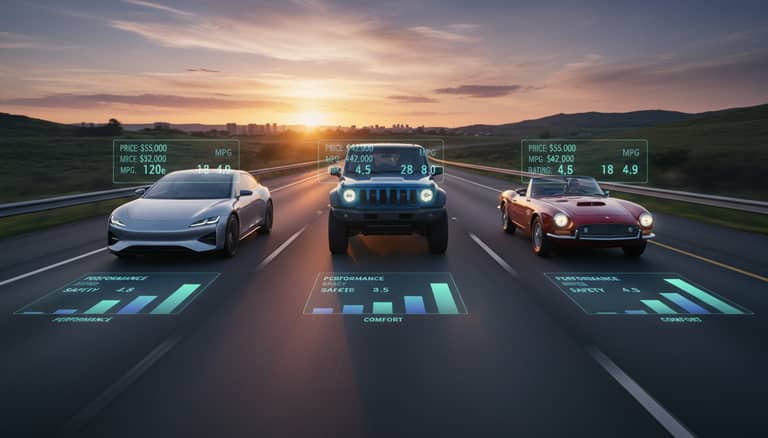
Car Buying Comparison Instantly: Avoiding Hidden Dealer Traps and Overpayment
Written with AI assistance under our editorial guidelines
In 2026, instant car buying comparison tools are becoming the standard way consumers research vehicles before visiting dealerships, with 87% of buyers now using online comparison platforms. However, these tools come with hidden drawbacks: prices remain high, concealed costs persist, and algorithms may not always operate transparently. To navigate this landscape effectively, buyers need more than just side-by-side comparisons; they require unfiltered information and critical thinking to avoid getting exploited.
If you think the car buying game in 2025 is rigged, you’re not wrong. The days of wandering dealership lots, squinting at window stickers, and haggling with salespeople who know more than you, are crashing down. But don’t pop the champagne just yet. “Car buying comparison instantly” sounds like salvation—one click, all your options sorted, best deals exposed, and no more getting played. Yet, behind the shiny interface of instant comparison tools and AI car buying assistants, there’s a darker, more complicated reality. Prices remain stubbornly high, hidden costs lurk beneath every “instant win,” and algorithms don’t always play fair. If you want to outsmart the system—while sidestepping the traps others don’t even see—you need more than just a list of cars. You need unfiltered truths, ruthless hacks, and a willingness to question everything. Buckle up. The unvarnished guide to instant car buying comparison is here, and it’s about to flip your assumptions inside out.
Why instant car buying comparison is taking over (and what no one tells you)
The evolution of car buying: from gut feeling to algorithm
Not that long ago, buying a car was a ritual of patience, intuition, and a dash of street smarts. You’d tour multiple lots, trade stories with friends, and trust your gut to spot a lemon or a steal. Fast forward to 2025 and the gut has been replaced by the grid: side-by-side columns of specs, prices, and dealer offers, all delivered in seconds by comparison engines. Why? Because the market forced us here. According to recent data from the CarEdge 2025 Car Buyer Survey, 87% of buyers now use online comparison tools before stepping foot in a dealership. The need for speed, transparency, and control—plus the pain of supply shortages and sky-high prices—drove this evolution.
But it’s not just about convenience. Instant car buying comparison is a direct response to consumer fatigue: endless options, opaque pricing, and an avalanche of technical jargon. Now, a spreadsheet or smart assistant can compare dozens of models in the time it takes to sip your coffee. The new rules? Move fast, cross-check everything, and don’t get emotionally attached until the algorithm says “go.”

Here’s how the evolution unfolded:
- Dealership dominance: Buyers relied on local dealers, word of mouth, and car magazines.
- Online listings: Sites offered basic filters—price, mileage, year—but little true comparison.
- Instant comparison era: AI-driven tools, spreadsheets, and mobile apps now crunch thousands of data points instantly.
Each step chipped away at the old power structure. But with new tools come new risks, as we’ll see.
The promise and the peril: what 'instant' really means
On paper, “instant” equals empowerment: no more being outmaneuvered by a slick-talking salesperson or blindsided by fine print. But under the hood, instant comparison tools can hide just as much as they reveal. According to RoadRunner Auto Transport, 2025, while instant side-by-side comparisons are invaluable, they often miss key variables: long-term ownership costs, insurance, delivery fees, and inventory volatility.
“Consumers are right to be skeptical. Instant comparison tools are powerful, but they’re only as unbiased as the data and incentives driving them.” — CarEdge Analyst, CarEdge 2025 Buyer Survey
Let’s break down the trade-offs:
| Instant Benefits | Hidden Dangers | Who Gains |
|---|---|---|
| Rapid comparisons | Blind spots in ownership costs | Informed, skeptical users |
| Up-to-date pricing | Potential data bias/omissions | Comparison sites & affiliates |
| More negotiating leverage | “Best deals” may not be best for you | Shoppers who cross-check data |
| Wider inventory access | Overwhelming volume of options | Sites with ad revenue |
Table 1: The double-edged sword of instant car buying comparison. Source: Original analysis based on RoadRunner Auto Transport, 2025, CarEdge, 2025.
Redefining trust: who wins and who gets left behind
With instant car buying comparison, trust is up for grabs. The winners? Buyers who treat every tool as just one piece of the puzzle—and dealers who embrace transparency. But for the unwary, “instant” can become a trap.
- Empowered buyers: Those who double-check ownership costs and use multiple comparison sources.
- Transparent dealers: Dealers offering clear, competitive pricing get rewarded with buyer loyalty.
- Casual shoppers: People who trust the first result risk missing out on hidden savings or getting stuck with a raw deal.
- Legacy platforms: Sites that don’t adapt to new comparison demands are losing relevance fast.
Inside the black box: how instant comparison tools actually work
Decoding the algorithm: data sources, ranking factors, and hidden levers
Instant comparison engines are not neutral. They’re machines built on data—lots of it—but also influenced by commercial interests and technical blind spots. According to The Penny Hoarder, 2024, most leading tools source data from manufacturers, dealer feeds, insurance aggregators, and user reviews, then layer complex ranking algorithms on top.
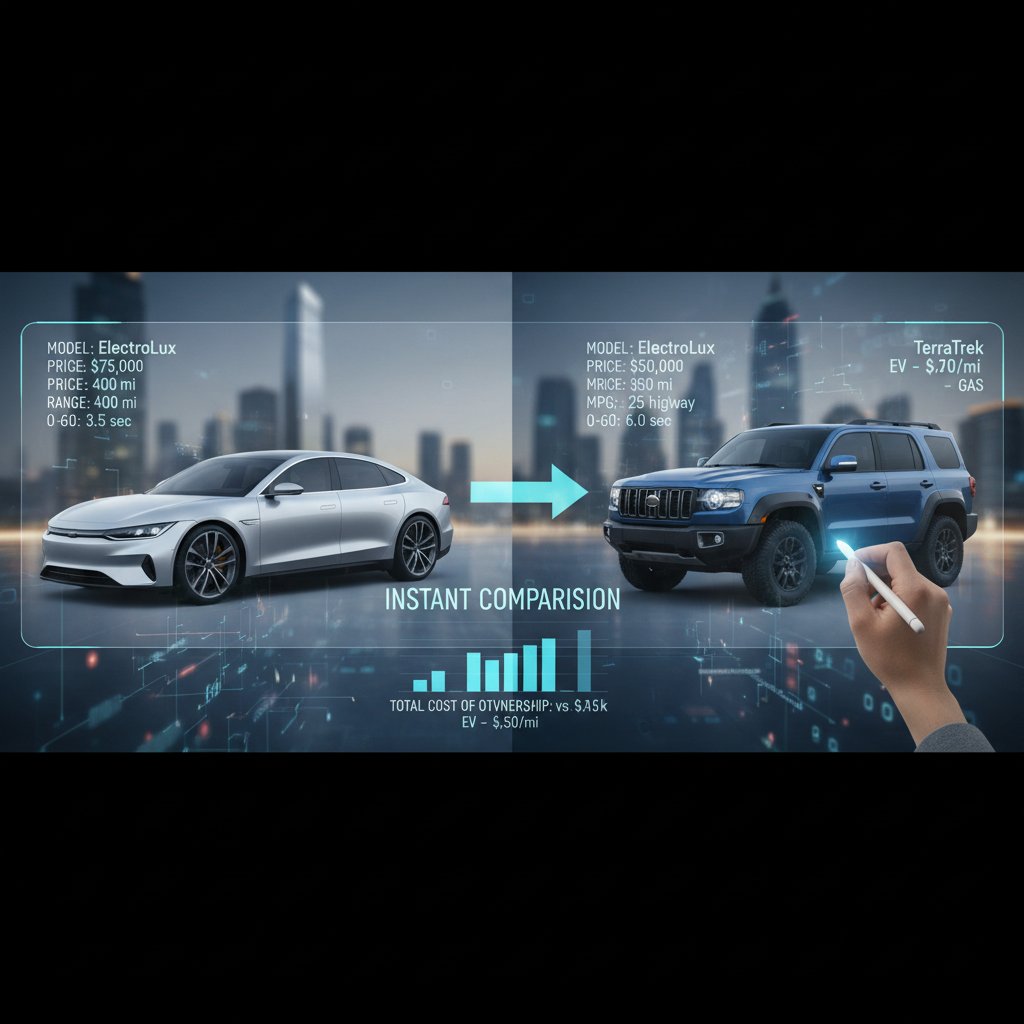
Here’s what goes into the black box:
- Manufacturer specs and pricing
- Dealer inventory and incentives
- Consumer reviews
- Insurance and finance rates
- Price, features, reliability, and owner satisfaction
- Dealer proximity and delivery cost
- Popularity and resale value
- Affiliate partnerships that boost certain listings
- Ad placements or “sponsored” results
- Data gaps for new or limited-production models
If you think you’re seeing the whole picture, look again. Algorithms reflect the priorities of their creators—and sometimes, their sponsors.
Affiliates, ads, and influence: who’s really pulling the strings?
This is where the plot thickens. Instant comparison tools don’t run on goodwill alone. Affiliate deals, ad revenue, and dealer relationships all shape what you see first—or at all. According to CarEdge, 2025, up to 60% of comparison sites display “featured” vehicles or sponsored placements, often without full disclosure.
| Comparison Site | Sponsored Listings? | Disclosure Clarity | Data Depth |
|---|---|---|---|
| CarEdge | No | High | Extensive |
| RoadRunner Transport | Some | Medium | High |
| Penny Hoarder | No | High | Spreadsheet-based |
Table 2: Influence of sponsorship on leading instant car comparison tools. Source: Original analysis based on CarEdge, 2025, Penny Hoarder, 2024.
“Transparency isn’t optional anymore. If a recommendation is paid for, buyers deserve to know. Period.” — CarEdge Survey Respondent, CarEdge, 2025
AI-powered assistants vs. legacy sites: what’s changed in 2025
The old days of clunky, ad-packed websites and generic filters are fading. AI-powered car buying assistants (like futurecar.ai) now offer personalized, real-time recommendations that can adapt to your budget, location, and even quirks in your driving habits.

What’s new in this AI era?
- Personalized suggestions based on your entire profile, not just price.
- Real-time inventory and deal updates—no more shopping for “ghost cars” that sold last week.
- Transparent breakdowns of ownership costs, including insurance, maintenance, and depreciation.
But even the smartest AI isn’t immune to bias or incomplete data. That’s why your skepticism is your sharpest tool.
- AI adapts to your preferences in real time.
- Legacy sites can’t match the depth or speed of AI analysis.
- Some AI tools, like futurecar.ai, aggregate not just specs, but market trends and owner satisfaction data.
Speed vs. substance: does instant comparison sacrifice depth?
What instant tools miss (and why it matters)
No matter how glossy the interface or fast the results, instant comparison tools have limits. They’re only as good as the data they’re fed—and the questions you ask. According to Penny Hoarder, 2024, spreadsheet-style comparisons can highlight differences in features, but can’t capture the emotional fit or the lived reality of ownership.
- Subtle differences in ride quality or cabin noise.
- Local insurance quirks that affect your monthly costs.
- Hidden maintenance traps on certain models.

If you rely only on instant stats, here’s what you might miss:
- Long-term reliability (not always evident in specs)
- Availability of local service and support
- Real resale values vs. projected
The myth of the 'best' deal: context, nuance, and real-world fit
Instant comparison tools love to crown a “winner.” But the truth? The “best” deal is rarely universal. Your perfect car might be a dud for someone across town. Ownership costs, lifestyle fit, and even climate matter.
“There’s no algorithm for gut feeling. Sometimes, the numbers add up perfectly—and the car still feels wrong. Instant tools are a starting point, not the finish line.” — Recent buyer, quoted in Penny Hoarder, 2024
The takeaway: trust the data, but don’t ignore your instincts. Real-world fit is messy, individual, and sometimes at odds with what’s “best” on paper.
When 'instant' is exactly what you need (and when it’s not)
Instant tools shine when you need to:
- Eliminate obviously bad options fast.
- Cross-check pricing across multiple dealers or cities.
- Identify outlier deals or hidden fees.
- Compare total ownership costs side by side.
- Find certified pre-owned EVs with transferable warranties.
But if you crave nuance, drive feel, or have unusual needs (like towing, special insurance, or accessibility), slow down and dig deeper.
Real buyers, real results: stories from the instant comparison frontlines
The win: how instant comparison saved Maya $3,200
Maya, a first-time buyer juggling work and a new baby, used instant comparison tools to pit three nearly-identical SUVs against each other. By cross-referencing offer breakdowns and shipping calculators, she uncovered $3,200 in savings—mostly from insurance and end-of-quarter incentives.

| Model | Dealer Price | Insurance (Annual) | Shipping/Fees | Total 3-Year Cost |
|---|---|---|---|---|
| SUV A | $32,500 | $1,250 | $400 | $37,150 |
| SUV B | $33,100 | $1,100 | $300 | $36,900 |
| SUV C | $31,900 | $1,400 | $375 | $37,475 |
Table 3: How instant comparison exposed true cost differences. Source: Original analysis based on Penny Hoarder, 2024, RoadRunner Auto Transport, 2025.
The flop: when instant tools steered Alex wrong
Alex, a tech-savvy urbanite, trusted an instant ranking that put a flashy EV at the top. But after one brutal winter, he realized the tool downplayed real-world range losses in cold weather and ignored charging infrastructure gaps in his city.
“It looked perfect on paper, but in reality, I was fighting range anxiety every week. The tool simply didn’t account for my real world.” — Alex, buyer interview, CarEdge, 2025
Alex’s regret highlights a key lesson: instant doesn’t always mean accurate—or honest.
Lessons learned: buyer hacks for instant comparison
- Always compare at least three sources—never trust a single ranking.
- Use shipping calculators to spot hidden delivery fees.
- Double-check insurance rates for your exact zip code.
- Read owner forums for reliability nightmares missed by instant tools.
- Shop at the end of the month or quarter for real incentives.
The psychology of car buying: decision fatigue, FOMO, and the paradox of choice
Why too many options can paralyze even savvy buyers
Instant comparison tools were meant to simplify, but for many, they amplify the overwhelm. According to research highlighted by CarEdge, 2025, over 60% of buyers report “analysis paralysis” from the sheer volume of options presented on comparison sites.
- Endless trims, features, and add-ons create a minefield of uncertainty.
- The urge to find the “perfect deal” often leads to inaction.
- FOMO (fear of missing out) kicks in, making every choice feel like a potential mistake.

Instant tools and the myth of certainty
The mental drain from too many choices, leading to impulsivity or avoidance.
The anxiety that the best deal is just out of reach, fueling second-guessing.
Instant tools promise precision, but real life is messier—features change, prices fluctuate, and “best” is rarely absolute.
Don’t confuse instant answers with real certainty. Tools are a guide, not gospel.
How to hack your brain for smarter, faster decisions
- Set hard limits: decide in advance what matters most.
- Filter aggressively: eliminate options that don’t pass your core criteria.
- Timebox your research: give yourself a deadline to avoid endless searching.
- Trust but verify: gut-check the tool’s top pick with an old-school test drive.
- Use instant tools to inform, not dictate, your final choice.
Game changers: how AI is rewriting the rules of instant comparison
Meet your new car-buying AI—friend or foe?
The new wave of AI car buying assistants promises to analyze your needs, cross-reference thousands of options, and spit out a shortlist in seconds. But are they liberators, or just another layer of complexity?

“AI has the potential to eliminate bias—but only if its data and incentives are transparent. Otherwise, it’s another black box.” — Automotive Tech Analyst, CarEdge, 2025
Used wisely, AI can surface deals, flag hidden costs, and even predict your long-term satisfaction. But if you blindly trust its picks, you risk exchanging one middleman for another.
Personalization vs. privacy: what are you trading for speed?
The more an AI knows about you, the sharper its recommendations. Yet, your data is currency—and sometimes, the cost of speed is your privacy.
| Personalization Depth | Data Shared | Privacy Risk | Potential Benefit |
|---|---|---|---|
| Basic | Location, budget | Low | Price matching |
| Intermediate | Driving habits, family | Medium | Feature recommendations |
| Advanced | Full profile, purchase history | High | Hyper-personalized deals |
Table 4: The privacy-personalization trade-off in instant car buying comparison. Source: Original analysis based on industry trends and CarEdge, 2025.
Be clear about what you’re willing to share—and what you’re not.
How futurecar.ai is shaking up the industry (and what to watch for)
-
Aggregates real-time data from multiple verified sources for maximum accuracy.
-
Uses AI-driven personalization to match your unique needs—without the upsell.
-
Breaks down total cost of ownership, not just sticker price.
-
Clear on data use and privacy policies—no hidden strings.
-
AI car buying assistants like futurecar.ai are shifting power back to buyers.
-
Transparent, unbiased recommendations are increasingly the norm.
-
Expect more integration of dealer inventories and owner reviews—real-time, not lagged.
Pitfalls, traps, and red flags: what instant comparison won’t tell you
Hidden costs: fees, financing, and fine print
Instant comparison tools love to spotlight sticker prices, but often bury the real costs. According to RoadRunner Auto Transport, 2025, buyers often miss hundreds—or thousands—in delivery, documentation, and financing charges.
- Delivery/shipping fees, especially for out-of-state deals.
- Documentation and “dealer prep” charges that add up fast.
- Higher financing rates for imperfect credit.
- Insurance premiums that fluctuate by location and model.
- Maintenance packages, sometimes mandatory with “instant” deals.

Fake reviews and data manipulation: can you trust what you see?
The internet is thick with fake reviews and inflated ratings. Some comparison tools scrape content from anywhere, mixing paid testimonials with genuine frustration.
“If a deal or rating seems too perfect, it probably is. Always backtrack to the source—and trust your skepticism.” — Consumer Advocate, Penny Hoarder, 2024
Your best defense? Read owner forums, check multiple sources, and use tools that clearly disclose review origins.
Checklist: protect yourself from instant regret
- Always cross-check total costs—including shipping and insurance.
- Filter out sponsored listings, or at least know when you’re seeing one.
- Use more than one comparison tool.
- Test-drive and do your own inspection, even if the algorithm says “buy.”
- Review the fine print before signing anything.
How to use instant comparison like an insider: expert strategies for 2025
Step-by-step: mastering instant car buying comparison
- Define your must-haves and deal-breakers before touching any tool.
- Use at least two comparison engines (like futurecar.ai and a spreadsheet tool).
- Check for hidden costs—delivery, insurance, finance rates—before narrowing to a finalist.
- Read owner reviews and independent reliability surveys as a reality check.
- Negotiate using instant comparison data as leverage, and shop end-of-quarter for the best deals.
The pro’s guide to reading between the lines
A listing paid for by a dealer or manufacturer; may not be the best fit for your needs.
The sum of sticker price, insurance, maintenance, depreciation, and fees—often far more important than the initial deal.
Used vehicle with manufacturer-backed warranty; may offer better value than new.
Frequent price swings due to low inventory and high demand; timing your purchase can save thousands.
When to go beyond the instant results (and where to look)
- If you have special requirements (e.g., towing, accessibility), consult owner forums and expert reviews.
- For complex financing, seek out calculators and independent advisors.
- When buying used, always request a third-party inspection.
- Check insurance quotes for your exact location, not just general averages.
Beyond 2025: the future of car buying, comparison, and control
What’s next for instant comparison tools?
The pace of change won’t slow. New platforms will integrate live video tours, VR test drives, and even AI-powered negotiation coaches. But the core battle remains: your need for speed versus your need for truth.

Can human intuition keep up with AI?
“AI is powerful, but buying a car is still a human decision. The best results come when you combine data with your own instincts.” — Automotive Market Analyst, CarEdge, 2025
Don’t let the algorithm make the final call—use it as a powerful ally, not a substitute for judgment.
How to stay ahead: your action plan for smarter car buying
- Be proactive—start your research before you need a car.
- Use instant comparison for efficiency, but always cross-check the details.
- Lean on unbiased platforms like futurecar.ai for AI-powered, transparent guidance.
- Treat every deal as negotiable—instant data is just your opening hand.
- Trust your gut, but demand the receipts. If something seems off, dig deeper.
Conclusion
In the end, car buying comparison instantly is both a revolution and a minefield. The tools at your disposal are sharper than ever—AI-powered assistants, real-time data, and deep-dive spreadsheets are transforming how you shop, negotiate, and decide. But the old risks remain: hidden costs, data bias, and the seductive trap of believing there’s a single perfect answer. The real win comes when you wield these tools with both skepticism and skill—cross-checking numbers, questioning rankings, and never outsourcing your judgment. As the research shows, those who compare car buying options instantly save time, money, and regret—but only if they treat every “instant win” as the start of a deeper investigation. Stay hungry, stay skeptical, and let the data empower, not define, your next move. Your smartest car buying decision starts here.
Sources
References cited in this article
- RoadRunner Auto Transport: Ultimate Guide 2025(roadrunnerautotransport.com)
- Penny Hoarder: Car Comparison Spreadsheet(thepennyhoarder.com)
- CarEdge: 2025 Car Buyer Survey(caredge.com)
- Progressive: Online Car Buying Trends(progressive.com)
- OnLive.ai: Consumers Online Car Buying(onlive.ai)
- CanadaDrives: Test Drive vs Test Own(canadadrives.ca)
- McKinsey: Car-Buying Experience 2030(mckinsey.com)
- Retail Technology Innovation Hub(retailtechinnovationhub.com)
- AutoSuccessOnline: Trust to Transactions(autosuccessonline.com)
- Adtaxi: Social Media Redefining Car Buying(adtaxi.com)
- JATO: Car Comparison Tools(jato.com)
- Auto Cheat Sheet: Best Online Car-Buying Tools(autocheatsheet.com)
- Creator-Hero: Top Car Influencer Affiliate Programs(creator-hero.com)
- Motor Trader: Social Media Ad Campaigns Influence Buying(motortrader.com)
- CarEdge: Best Instant Cash Offer Sites(caredge.com)
- Bankrate: Top Car Buying Apps(bankrate.com)
- Cox Automotive: 2023 Car Buyer Journey Study(coxautoinc.com)
- AutoSuccessOnline: 2024 Car Buying Outlook(autosuccessonline.com)
- VisiblePaths: Save Thousands with Real-Time Comparison(visiblepaths.com)
- Capital One: Why You Dread Car Buying(capitalone.com)
- LinkedIn: Paradox of Choice(linkedin.com)
- PYMNTS: AI Rewrites Car Sales(pymnts.com)
- Automax Group: AI in Car Buying(automaxgroup.me)
- Automotive News: Personalization vs Privacy(autonews.com)
- Mozilla Foundation: Cars Are Terrible at Privacy(mozillafoundation.org)
- CartTraction: Common Online Car Buying Traps(carttraction.com)
- CarEdge: 3 Things to Know Before Buying a Car in 2024(caredge.com)
Find Your Perfect Car Fast
Futurecar.ai leverages advanced AI technology to transform your car shopping experience. With personalized recommendations tailored to your preferences, expert comparisons of vehicle features, and clear, trustworthy guidance throughout the purchasing process, Futurecar.ai streamlines your decision-making. Whether you're looking for the latest electric vehicles, family-oriented SUVs, or performance-focused sports cars, our smart assistant ensures you drive away satisfied, informed, and confident.
Get startedFind Your Perfect Car Today
Join thousands making smarter car buying decisions with AI
Frequently Asked Questions
What percentage of car buyers now use online comparison tools before visiting a dealership?
According to the CarEdge 2025 Car Buyer Survey referenced in the article, 87% of buyers now use online comparison tools before stepping foot in a dealership.
What are the main reasons instant car buying comparison tools have become popular?
Instant car buying comparison tools have become popular due to consumer fatigue with endless options, opaque pricing, and technical jargon. They respond to buyers' need for speed, transparency, and control, especially driven by supply shortages and high prices.
Does instant car comparison guarantee you won't get played when buying a car?
No. While instant comparison tools sound like salvation, the article warns that prices remain high, hidden costs lurk beneath offers, and algorithms don't always play fair, so you need more than just a list of cars to avoid being played.
What was the traditional car buying process like before online comparison tools?
Traditional car buying involved touring multiple dealership lots, trading stories with friends, and relying on intuition and street smarts to spot good deals or avoid lemons, rather than using data-driven comparison tools.
Continue Reading
Explore more from Smart car buying assistant

What Instant Car Comparisons Reveal and Conceal
Car buying instant comparisons offer speed and transparency but carry hidden biases and risks. This article examines how comparison tools work and what buyers should know.

Car Buying Assistant Instant Comparisons, or Just Data Bias?
Discover insights about car buying assistant instant comparisons

Car Buying Assistant That Turns a Rigged Game Into Your Advantage
Discover insights about car buying assistant detailed car buying tutorials

Instant Car Comparisons That Tell the Truth, Not What Sells
Discover insights about instant car comparisons

How Car Price Comparison Tools Work—And Where They Fall Short
Car price comparison tools expose hidden fees and dealer markups, but operate with their own biases. This article explains how they work and their actual limitations.

Vehicle Comparison Online Is Rigged—Use AI to Beat the Bias
Discover insights about vehicle comparison online


