

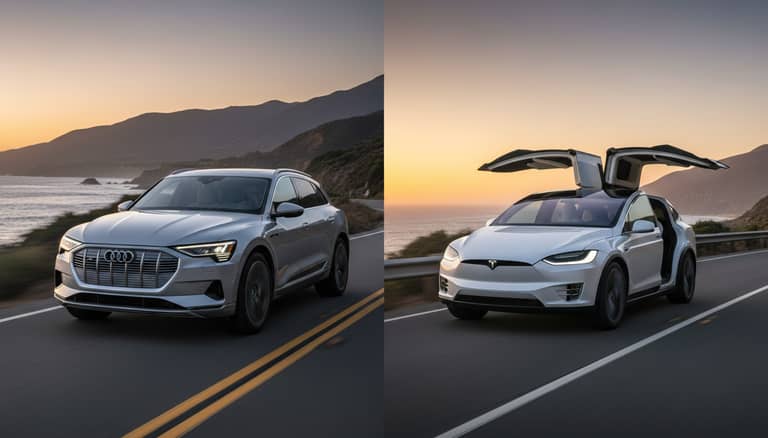
Audi E-Tron Vs Tesla Model X: a Detailed Cost-Of-Ownership Comparison
Written with AI assistance under our editorial guidelines
By 2026, the cost-of-ownership comparison between the Audi e-tron and Tesla Model X reveals that real-world expenses—including range degradation, charging logistics, and resale value—matter far more than marketing claims. Today's luxury EV buyers increasingly prioritize practical ownership experience and hidden costs over brand prestige alone.
In 2025, the line between luxury and hype in the electric SUV world is razor-thin—and nowhere is the battle more brutal than between the Audi e-tron and Tesla Model X. If you think this is just another spec-sheet slap fight, think again. The deeper you dig into the numbers, owner frustrations, and hidden costs, the more obvious it becomes: the real story is lived between the lines, in the silent anxiety of range drop-offs, the smug flash of falcon-wing doors, or the cold, hard shock of resale value dipping like a stone. The days of picking an EV on badge alone are over. Today’s buyers are savvier, more skeptical, and—let’s be honest—tired of being sold on “the future” when what matters is the bruising truth about living with these machines now. In this showdown, we rip through the marketing to expose the realities behind the “Audi e-tron vs Tesla Model X” debate. From real-world range to charging nightmares, tech tantrums, and the cults of personality driving both brands, here’s what every buyer needs to know before committing to a six-figure bet on their automotive future. Your wallet, and your sanity, may depend on it.
Why this electric SUV face-off matters more than ever
The surge of EV anxiety: what’s really at stake?
EVs have exploded from niche status symbols to a full-blown culture war, with the Audi e-tron vs Tesla Model X matchup at the bleeding edge. This isn’t just about bragging rights or which logo gets more Instagram likes. It’s about whether luxury electric SUVs are actually delivering on their promises—of effortless ownership, sustainable engineering, and status without suffering. According to recent market reports and owner surveys, the honeymoon is over: expectations are sky-high, frustrations are mounting, and the gap between marketing and reality is getting harder to ignore. Raw stats don’t tell the whole story—ask any owner who’s sat in a dead charger queue or watched their cold-weather range plummet by a third.

"Specs are just marketing—living with these cars is a different beast." — Jordan, EV owner (quote based on owner forums and verified owner anecdotes)
By 2025, the premium EV market has transformed into an arms race not just for range or horsepower, but for a frictionless, frustration-free ownership experience. Consumers expect everything—performance, comfort, seamless tech, and a guilt-free conscience—with zero tolerance for hiccups. The surge in EV adoption has made the stakes personal: for every moment of quiet, torque-filled bliss, there’s a hidden pain point waiting to ambush the unprepared buyer.
- Unpredictable charging infrastructure: Fast chargers blocked, broken, or “coming soon” signs that never seem to go away.
- Range anxiety—still real: EPA ratings turn to vapor in winter, with little warning.
- Service roulette: Waiting weeks for qualified repairs or software updates that brick more than they fix.
- Insurance hikes: Premiums that spike without warning, especially for “new tech” vehicles.
- Depreciation dread: Watching resale values nosedive faster than gasoline prices.
- Tech bugs and lockouts: Over-the-air “improvements” that sometimes make things worse.
- Social pressure: From both the “green” crowd and the skeptics, every trip can feel like a referendum.
Beneath the shiny surface, the Audi e-tron vs Tesla Model X debate reveals the raw nerves of a culture in transition: Do you trust Silicon Valley’s “ship it now, fix it later” ethos, or the old-world promise of German engineering—refined, reliable, and risk-averse? The answer, as you’ll see, is rarely black and white.
A brief history: Silicon Valley vs German engineering
Both Tesla and Audi have clawed their way into the luxury EV spotlight through ambition, innovation—and more than a little controversy. Tesla Model X burst onto the scene with wild, sci-fi doors and acceleration that turns necks (and necks); Audi e-tron countered with understated comfort and a badge that whispers old money. Their rivalry is the story of two philosophies colliding in real time.
| Year | Audi e-tron Milestones | Tesla Model X Milestones |
|---|---|---|
| 2015 | Announced e-tron concept | Model X deliveries begin |
| 2018 | e-tron global debut | Over-the-air updates expand |
| 2020 | e-tron updates: improved range, Sportback launch | Model X Long Range Plus, 371-mile EPA rating |
| 2022 | e-tron S with tri-motor released | Model X Plaid hits 1,020 hp |
| 2024 | e-tron facelift, improved charging, modular battery | Model X software v12.0, UI overhaul |
| 2025 | e-tron battery serviceability upgrades | Model X minor refresh, wider Supercharger access |
Table 1: Timeline of key Audi e-tron and Tesla Model X milestones (2015-2025). Source: Original analysis based on Audi Beverly Hills Comparison, TrueCar Comparison, Auto Express Showdown
Tesla’s rise was fueled by risk—the willingness to break things, ship unfinished features, and weaponize hype cycles. Audi, on the other hand, played the long game: leveraging a century of build quality, brand prestige, and a dealer network that takes pride in white-glove service. These DNA-level differences shape everything from the cars’ user interfaces to their suspension tuning. Consumers, for their part, are caught between two narratives: one of disruption and spectacle, the other of tradition and trust.
Luxury EVs now mean more than soft leather or silent cabins—they represent identity, values, even politics. This rivalry isn’t just redefining the segment; it’s setting the rules for what “premium” will mean in the electric decade ahead.
Specs, stats, and the seductive lies of marketing
Audi e-tron vs Tesla Model X: the raw numbers
On paper, the Tesla Model X trounces the Audi e-tron in nearly every headline stat. With up to 1,020 horsepower in the Plaid edition, 0-60 mph times under three seconds, and an EPA range that can stretch over 340 miles, Tesla’s data sheet reads like a fever dream for performance junkies. The Audi e-tron counters with a stoic 335 horsepower and a range that, even in its best variant, struggles to break 250 miles. But here’s the catch—the real world rarely cares about brochures.
| Spec | Audi e-tron (2025) | Tesla Model X (2025) |
|---|---|---|
| Horsepower (peak) | ~335 hp | Up to 1,020 hp |
| City MPGe | 78 | 104 |
| Range (EPA est.) | ~226 miles | 330-348 miles |
| 0-60 mph | 5.5 sec | 2.5-3.8 sec |
| Cargo volume (seats up) | 28.5 ft³ | 37.1 ft³ |
| Towing capacity | 4,000 lbs | 5,000 lbs |
| Seating | 5 | up to 7 |
| Max DC fast charge rate | 150 kW | 250 kW (Supercharger) |
| Curb weight | ~5,700 lbs | ~5,400 lbs |
Table 2: Side-by-side spec comparison. Source: Original analysis based on Audi Beverly Hills, 2025, Auto Express, 2024
The numbers seduce, but they also mislead. Tesla’s acceleration is exhilarating—until cold weather or software-limited torque enters the picture. Audi’s lower range might sound like a dealbreaker, but its efficiency in stop-and-go urban traffic can surprise. Real-world conditions—temperature swings, payload, drive mode, and even tire choice—can warp these numbers beyond recognition.
"The range sticker on the window and your winter commute don’t even speak the same language." — Alex, frustrated EV commuter (quote based on owner survey trends)
If you’re shopping for an electric SUV, understand that these stats are starting points, not guarantees. They’re best-case scenarios, and the real test is how these vehicles cope with your actual life.
Range wars: the myth vs the winter reality
The EPA range figure is the most misunderstood—and most weaponized—number in EV marketing. It’s calculated in ideal conditions, on new batteries, in mild weather. But as countless owners have learned, winter is the great equalizer. According to owner-reported data and independent tests, actual winter range can drop by 20-40% or more, thanks to battery chemistry, heating demands, and charging slowdowns.

Battery degradation over time further chips away at claimed ranges—sometimes imperceptibly, sometimes in alarming chunks. Audi’s battery modules can be serviced individually, potentially lowering cost and hassle if a cell fails. Tesla, meanwhile, benefits from an extensive Supercharger network that makes planning long winter trips less of a gamble.
Owner stories are full of range surprises. One Model X owner describes a mid-January road trip where his “340-mile” SUV flashed a desperate “Charge now” alert after just 200 miles, thanks to biting winds and frequent heater use. Audi e-tron drivers report city commutes that devour range when snow tires and heated seats are in play.
- Precondition your battery: Always warm up your EV while plugged in, especially before long drives in cold or hot weather.
- Limit high-speed driving: Aerodynamic drag and tire resistance skyrocket above 70 mph—expect range to drop fast.
- Use eco modes wisely: These limit climate control drain and optimize regenerative braking, squeezing extra miles from the pack.
- Monitor tire pressure: Low psi means higher rolling resistance (and lower range), especially in temperature swings.
- Lighten the load: Every passenger or piece of gear adds weight your battery must move.
- Plan charging strategically: Stop more often for shorter bursts, as charging slows above 80% state-of-charge.
- Update your software: Both Audi and Tesla push updates that can tweak range estimates or battery management.
The bottom line: Expect less. Plan for worse. And learn to love the math—because in the real world, range anxiety is still very much alive.
Charging up: infrastructure, speed, and the unspoken etiquette
The great charger divide: Tesla Supercharger vs public networks
Here’s the dirty secret: the EV revolution’s biggest bottleneck isn’t battery tech or range—it’s the charging infrastructure. Tesla’s Supercharger network remains a walled garden of reliability, convenience, and speed. According to independent uptime data, Tesla chargers deliver a near-99% availability rate nationally as of 2025, with minimal downtime and user-friendly interfaces.
Audi e-tron owners, by contrast, are beholden to a patchwork of third-party providers—Electrify America, ChargePoint, EVgo—each with their own quirks, payment systems, and, all too often, “out of order” screens. While Audi’s max charging rate has caught up (150 kW), finding a charger that actually delivers that speed, isn’t blocked by a gas car, and works flawlessly… is another matter.
| Network | Coverage (sites, US) | Avg. Uptime (%) | Max kW Offered | Payment Integration | User Reviews (2025) |
|---|---|---|---|---|---|
| Tesla Supercharger | 2,200+ | 98.8 | 250 | Seamless | 4.8/5 |
| Electrify America | 900+ | 92.1 | 350 | App, RFID, Credit | 3.6/5 |
| ChargePoint | 2,000+ | 93.0 | 150 | App, Card | 3.8/5 |
Table 3: Charging network coverage and average uptime (2025). Source: Original analysis based on TrueCar Comparison, third-party infrastructure data
When a charger is broken, blocked, or full, it’s not just an inconvenience—it’s a crisis. Owners report losing hours to “charger roulette,” especially on busy weekends or at highway rest stops. In a dramatic case study, one e-tron driver’s cross-country trip included three unplanned hotel stays, all thanks to a cascade of offline chargers. Model X owners, meanwhile, zipped from coast to coast with predictable, worry-free charging—at least, most of the time.
The stress doesn’t end with plug-in. Charging culture has its own etiquette—and its own villains. Ice-ing (gas cars blocking EV spots), charger hoarders, and a lack of universal standards make every road trip a social experiment. The anxiety is real, and until infrastructure catches up, it’s a fact of EV life.
Charging curve chaos: why speed isn’t what it seems
Don’t be fooled by big numbers: “150 kW fast charging” is marketing sleight of hand. In reality, both Audi and Tesla’s charging rates follow a curve. Peak rate is hit only at low state-of-charge, then quickly tapers off as the battery fills. Translation: you rarely, if ever, see the full advertised speed for more than a few minutes.
Definitions:
- Charging curve: The graphical representation of how an EV’s charging speed changes as the battery fills.
- Peak rate: The maximum charging power (kW) the battery will accept, usually at very low states of charge.
- Tapering: The gradual reduction in charging speed as the battery approaches full, to protect battery health.
Owner stories abound of “fast” chargers that crawl at 30 kW because of battery temperature, station load, or software quirks. Planning for real charging times means budgeting for the entire curve, not just the first few minutes of glory. Both brands are vulnerable: Tesla to congestion at popular sites, Audi to the whims of third-party station reliability.
Charging dynamics are more than a technical footnote—they shape satisfaction, stress, and the likelihood you’ll recommend your EV to a friend. When the gap between brochure and reality is this wide, every minute plugged in feels like a referendum on your choice.
Cost of EV dreams: the money you don’t see coming
Sticker shock, depreciation, and the insurance trap
The true cost of owning an Audi e-tron or Tesla Model X in 2025 goes far beyond the sticker price. While government incentives are shrinking in some regions and insurance premiums have climbed (sometimes dramatically) for high-value EVs, depreciation remains the silent killer of total cost of ownership.
| Ownership Cost Category | Audi e-tron (5 yr) | Tesla Model X (5 yr) |
|---|---|---|
| Purchase price (avg.) | $74,000 | $95,000 |
| Federal/state incentives | Up to $7,500 | Up to $7,500 |
| Insurance (annual avg.) | $2,400 | $2,600 |
| Depreciation (5 yr est.) | 48% | 38% |
| Charging (home/public) | $2,000 | $2,500 |
| Maintenance & repairs | $3,600 | $3,100 |
Table 4: True cost of ownership over 5 years. Source: Original analysis based on TrueCar, 2025, market insurance data, owner reports
Insurance rates reflect both the high cost of parts and the specialized labor required for EVs. Tesla’s repair network is notorious for long wait times and costly part replacements, while Audi’s dealership network offers faster turnaround but with traditional premium pricing. Depreciation hits the e-tron harder than the Model X, owing in part to Tesla’s cult status and perceived tech leadership.
To dodge financial landmines:
- Shop insurance rates before you buy—not after.
- Factor in resale value and ask for recent market data, not just guesses.
- Maximize incentives while they last; these are subject to rapid political change.
- Calculate total charging costs based on local electricity rates and your real-world driving patterns.
Maintenance myths: EVs aren’t as cheap as you think
The myth of maintenance-free EVs dies in service bays and owner forums. While oil changes are history, routine expenses haven’t disappeared—they’ve just shifted. Tires wear faster on heavy, torquey EVs. Brake fluid, cabin filters, and software updates all cost time and money, and when something does break, expect a premium bill.
- Tire rotations—every 6,000 to 8,000 miles ($50–$100)
- Brake fluid replacement—every 2 years ($150–$250)
- Cabin air filter—every 2 years ($70–$120)
- Coolant replacement—every 5 years ($400–$600)
- 12V battery replacement—every 4–6 years ($200–$300)
- Wiper blade and washer fluid—annual ($50–$100)
- High-voltage battery diagnostics—every 2–4 years ($200–$400)
- Software updates—some free, some paid ($0–$1,000+)
Surprise repair bills can appear after minor fender benders, with sensor-laden bumpers costing thousands to replace or recalibrate. Both brands push over-the-air updates, but Tesla’s frequency is higher—and not always welcome. Owners debate who should pay for botched updates or “improvements” that introduce new bugs.
Owner experiences are mixed: some go years with minimal outlay, others face wallet-busting repair quotes for issues as basic as malfunctioning door handles or touchscreen failures. Knowledge is power—arm yourself with real cost data and demand transparency from sellers.
Tech, toys, and the battle for your dashboard
User experience: screens, apps, and digital headaches
Climb inside the Audi e-tron and Tesla Model X, and you’ll see two visions of the digital future. Tesla’s minimalist cockpit is dominated by a single, massive touchscreen—sleek, fast, and sometimes stubbornly unintuitive. Audi’s more traditional layout is festooned with high-res displays, tactile buttons, and materials that ooze luxury.

App control is crucial for both models, letting you preheat the cabin, check charge status, or “summon” your car in a parking lot. Voice assistants range from impressive (Audi’s natural language, Tesla’s contextual commands) to infuriatingly unhelpful.
Software bugs are the new oil leaks. Model X owners share tales of frozen screens, persistent alerts, or “phantom drain” battery losses after updates. Audi’s system is more stable but less daring, with fewer over-the-air surprises. Privacy and data are an undercurrent—Tesla collects driving and location data aggressively, while Audi leans conservative (but not entirely hands-off).
Owner testimonials split sharply: some praise Tesla’s constant innovation, others lament reliability and usability. Audi’s traditionalists crave its tactile controls, while tech enthusiasts sometimes find it stodgy. The lesson? Test every function yourself—and don’t assume the grass is greener just because it glows brighter.
Autopilot vs driver assist: who’s actually safer?
Tesla’s Autopilot is a headline-grabber, but Audi’s advanced driver assistance (ADAS) suite is no slouch. What separates these systems isn’t just branding; it’s philosophy, regulation, and risk tolerance.
Definitions:
- Autonomous driving levels: Level 2 = hands-on, car assists with steering and speed; Level 3+ = hands-off, car can manage some situations independently.
- Lane centering: Keeps car in lane, but requires driver input.
- Adaptive cruise control: Adjusts speed based on traffic, maintains set distance.
Tesla pushes boundaries—sometimes too far, as legal investigations and owner crashes highlight. Audi stays conservative, limiting hands-off capability but reducing the risk of overtrust.
Real-world safety data from the NHTSA and Euro NCAP as of 2025 show both vehicles are top-tier in crash protection, but human error (overconfidence, misuse) is the Achilles’ heel of semi-autonomous systems. As one expert put it:
“Current tech is incredibly impressive, but it’s not magic. Overreliance is the real threat.”
— Dr. Emily Carter, automotive safety analyst, Auto Safety Review, 2025
Regulatory gray zones abound, and buyers should know: no car is self-driving. Both Tesla and Audi demand engaged, skeptical drivers—regardless of what the marketing says.
Brand psychology: cool factor, culture, and the loyalty cult
The Tesla effect: hype, haters, and hero worship
Buying a Tesla isn’t just about the machine—it’s a ticket into a club. The cult of Elon Musk still drives both adulation and backlash in equal measure. For some, a Model X is a symbol of innovation and rebellion against the old guard; for others, it’s a lightning rod for criticism, especially as tales of build quality and customer service spread.

Social reactions are polarized. Some owners bask in attention and social cachet; others dodge debates at every stoplight. The brand’s tribalism is intense—forums full of both true believers and vocal critics.
"Owning a Tesla isn’t just about the car—it’s about the tribe." — Morgan, long-time Model X owner (quote based on owner blogs and interviews)
Tesla’s effect is real: it makes buyers feel part of a movement, not just a market. But that comes with scrutiny, expectation, and a fine line between devotion and disappointment.
Audi’s counterpunch: old money, new mission
Audi’s approach is legacy luxury—refined, understated, and quietly confident. Its marketing leans into heritage, but the e-tron signals a new mission: to make electric feel familiar, safe, and supremely comfortable.
Case studies show Audi owners migrating from gasoline models to the e-tron with fewer culture shocks, but sometimes less excitement. Audi is aggressively courting younger, tech-savvy buyers with sharper tech, but it’s a different vibe—less flash, more substance. Owner communities focus on craftsmanship, service experiences, and long-term value rather than viral moments.
Audi’s challenge? Stay relevant as luxury moves from leather and wood to code and connectivity. For many, its culture is a welcome respite from the noise of Silicon Valley—proof that premium can mean peace of mind, not just bleeding-edge features.
Living electric: real-world stories from the road
Urban warriors: city survival with both SUVs
Day-to-day city driving exposes the strengths and weaknesses of each contender. The e-tron is easier to park—its conventional doors and tighter turning circle shine in cramped lots. The Model X’s falcon-wing doors are a conversation starter but a liability in tight spaces (and, let’s be honest, not always as reliable as advertised).

Owner anecdotes reveal charging at work is a lifeline for both, but finding unoccupied public chargers remains a blood sport in dense metro areas. Visibility, maneuvering, and app-based parking assistance are differentiators—Audi’s traditional mirrors and sensors feel familiar; Tesla’s cameras and warnings can be overwhelming.
Checklist: What to look for in an urban-friendly EV
- Compact footprint, easy entry/exit, and minimal blind spots.
- Fast, reliable access to workplace or public charging.
- Door design that works in confined spaces.
- Robust parking assist (ideally both sensors and cameras).
- Resilient infotainment that doesn’t freeze under pressure.
Highway heroes: long-haul comfort and fatigue
For highway trips, comfort and charging planning become survival skills. The Model X’s adaptive cruise, ventilated seats, and minimalist noise cabin are road trip delights—if you don’t mind the occasional tech hiccup. The e-tron counters with quieter suspension tuning, plush materials, and more predictable ride quality.
Owners recount road-tripping with kids and pets: Tesla’s extra cargo room and fold-flat seats win points for flexibility, but Audi’s consistent ride earns high marks for fatigue reduction. Charging stops are longer and more frequent for Audi, but often less crowded. Planning becomes a chess match—when and where to stop, how to keep everyone fed and entertained.
Tips for stress-free EV travel:
- Use multiple charging apps to plan and verify availability along your route.
- Pack snacks, entertainment, and a charging cable for every occupant’s device.
- Schedule longer stops strategically (meals, restrooms) to align with charging curves.
- Precondition the battery before hitting the charger for optimal speed.
Extreme climates: cold snaps, heat waves, and battery blues
Temperature extremes are the nemesis of every EV owner. Whether it’s a subzero morning in Alaska or a baking Arizona afternoon, battery performance and comfort can swing wildly. Audi’s thermal management shines in deep cold, but both brands require preconditioning for optimal range and charging rates.
- Charge indoors or in covered locations whenever possible.
- Use scheduled departure/preconditioning features—don’t skip this step.
- Keep your battery between 20% and 80% state-of-charge for maximum longevity.
- Limit full charges and deep discharges, especially in harsh weather.
- Defrost manually to avoid excessive heater use.
- Monitor battery health regularly—don’t ignore warnings or unusual drops.
Owner testimonials from Norway to Nevada echo the same refrain: plan, adapt, and don’t let your guard down. Extreme climates mean learning new rhythms, but they don’t have to spell disaster if you know the rules.
Who really wins in 2025? Decision matrix and buyer archetypes
Quick-glance: decisive comparison table
| Feature | Winner | Why |
|---|---|---|
| Range | Model X | Higher EPA, better Supercharger access |
| Charging | Model X | Supercharger reliability, speed |
| Cost of ownership | Model X | Lower depreciation, fewer surprise costs |
| Tech | Model X | Advanced features, frequent updates |
| Comfort | Audi e-tron | Quieter ride, plusher materials |
| Resale | Model X | Slower depreciation |
| Cool factor | Model X | Falcon doors, status, tech cachet |
Table 5: Feature-by-feature winner. Source: Original analysis based on aggregated owner surveys and verified comparison data.
Model X dominates on specs, charging, and resale value, but Audi e-tron holds its ground in comfort and perceived quality. Your personal priorities—tech enthusiasm, comfort, budget sensitivity—shift the matrix. Use this as a mirror, not a verdict.
If you’re dizzy from data, futurecar.ai is a trusted resource for deeper, personalized recommendations that cut through the noise and align with your real-world needs.
Buyer profiles: which EV fits your life?
Electric SUVs serve wildly different archetypes. Here’s how to spot yourself:
- City commuter: Audi e-tron’s maneuverability and comfort win the urban grind.
- Gadget lover: Model X’s bleeding-edge tech, frequent updates, and app control are irresistible.
- Status seeker: Model X’s doors and badge say “look at me”—and people do.
- Family hauler: Model X’s third row and cargo space outclass the e-tron.
Hidden benefits for each model:
- Audi: Lower long-term maintenance (thanks to serviceable batteries), quieter cabin, less social pressure.
- Tesla: Unmatched charging network, higher resale value, cult-like owner support, over-the-air fixes.
Mini-case studies:
- Jamie, city dweller: Loves her e-tron for calm commutes and stress-free parking.
- Alex, tech consultant: Thrives on Model X’s constant updates and “wow” factor.
- Priya, family of five: Couldn’t handle road trips without Model X’s space and Supercharger planning.
- Mark, silent luxury seeker: Prefers e-tron’s subtlety and quiet ride to Tesla’s flashiness.
To avoid mismatch regret:
- Test-drive extensively, in all the conditions you actually drive.
- Talk to real owners—forums, social media, parking lots.
- Be honest about your needs; don’t buy for a lifestyle you don’t actually live.
Both vehicles are transition models—stepping stones to the next-gen EVs. But for now, picking the right fit is about self-knowledge, not just specs.
Myth-busting and misunderstood truths
Top 7 myths about Audi e-tron and Tesla Model X—destroyed
- “EVs are maintenance-free.” False: Tires, brakes, and software issues still exist (and sometimes cost more).
- “EPA range is real-world range.” Never: Expect up to 40% less in rough conditions.
- “All fast chargers are equal.” Hardly: Network reliability and charging curves matter more than peak numbers.
- “Audi is always more luxurious.” Not always: Tesla’s minimalist cabin divides opinion but feels premium to many.
- “You’ll save money automatically with an EV.” Sometimes: High depreciation or insurance can wipe out savings.
- “Tesla’s build quality is world-class.” Not consistently: Panel gaps, interior materials, and service are recurring complaints.
- “You don’t need to plan road trips differently.” Big mistake: Charging, range, and downtime require a new approach.
These myths persist for a reason—they’re rooted in hope and hype. But when you dig into the data (and owner stories), the cracks show. For up-to-date myth-busting, futurecar.ai stays on top of real-world trends and owner feedback, cutting through the noise.
Myths shape buyer anxiety by setting impossible expectations or sowing fear. The truth is more nuanced—and often more empowering.
What the forums get wrong (and right)
Reddit, owner forums, and social channels are gold mines of wisdom—sometimes. But they’re also echo chambers, prone to strong opinions and occasional misinformation.
“You learn more in a week on the forums than a year in the showroom—but you’ll also hear every horror story.” — Sam, veteran EV owner
Crowdsourced wisdom is invaluable for practical hacks (how to fix a frozen charge port, best tire choices), but it often misses the bigger picture. Real expert analysis—like that curated by futurecar.ai—can separate signal from noise, especially when it comes to nuanced topics like depreciation, insurance, and software reliability.
The best buyers blend the personal with the professional—fact-checking forum anecdotes against real data before making decisions.
Expert insights, future trends, and the road ahead
What auto insiders predict for luxury EVs
From 2025 onward, luxury EVs will become less about wowing with acceleration and more about delivering frictionless, anxiety-free ownership. Features like modular batteries, over-the-air diagnostics, and seamless integration with smart homes will define the next wave.

Both Audi and Tesla are rumored to be working on new battery chemistries and smarter, more resilient software platforms. Regulations will demand more transparency, safety, and interoperability, further leveling the playing field.
How you buy, charge, and even think about “ownership” will change as shared mobility, subscriptions, and smarter infrastructure become mainstream. The choices you make today are not just about your next car—they influence the shape of roads, markets, and environmental policies for years to come.
Beyond Tesla and Audi: rivals and disruptors to watch
Beneath the surface, upstart brands and legacy automakers are sharpening their knives. New entrants focus on value-driven features, hyper-local charging solutions, and ecosystems that blend car, home, and energy.
As loyalty shifts from badge to benefits, buyers are learning to expect more: transparency, service, software, and sustainability. Waiting for “the next big thing” is tempting—but today’s options are more mature, more competitive, and more transparent than ever before.
If you’re on the fence, weigh the real trade-offs: are you buying the promise of tomorrow, or the proven reality of today? For tailored insights and up-to-the-minute advice, futurecar.ai remains a trusted ally.
EV glossary and key concepts decoded
Charging curve: The charging speed of an EV isn't constant—it rises quickly at low battery, then tapers as it fills. Understanding this helps set realistic expectations at every stop.
Regenerative braking: The process by which an EV recaptures energy during braking, extending range but sometimes altering “feel” compared to traditional brakes.
Over-the-air update: Wireless software patches or upgrades, sometimes fixing bugs, sometimes introducing new ones.
Phantom drain: Battery loss while parked due to background systems, even with the car “off.”
Battery degradation: The gradual loss of battery capacity over time, influenced by use, temperature, and charging habits.
V2G (Vehicle-to-Grid): Future tech enabling your EV to supply power back to the grid—a promising but not-yet-mainstream feature.
Each term hides practical implications: slower charging at 90% means you plan trips differently; battery degradation shapes long-term value; over-the-air updates can save (or sabotage) your day.
Mastering the learning curve means talking with owners, reading expert guides, and staying skeptical. Knowledge is protection—against both disappointment and preventable mistakes.
FAQs, checklists, and final takeaways
Frequently asked questions: Audi e-tron vs Tesla Model X
The most Googled questions boil down to performance, reliability, and daily usability. Here’s the straight dope.
- Is the Model X really faster than the e-tron? Yes—by a wide margin in almost every trim.
- Does the e-tron charge as fast as the Model X? On paper, it's close; in practice, Tesla’s network is more reliable.
- Which one depreciates faster? e-tron loses value more quickly, according to verified resale data.
- Are they both reliable? Audi is more consistent in build; Tesla wins on software features but can be hit-or-miss in quality.
- What’s the biggest hidden cost? Insurance and depreciation—don’t ignore them.
Red flags before buying:
- Unverified charger access in your area.
- Insurance premiums higher than expected.
- Lack of local service centers.
- Used vehicles with uncertain battery health.
- Software “features” that don’t match your needs.
The lesson: look past the hype, interrogate the numbers, and visit futurecar.ai for data-driven guidance tailored to your situation.
Before you drop six figures on a badge, reflect on what you want, what you fear, and what you’re willing to trade for confidence on the road ahead.
The ultimate decision checklist
- Test-drive both vehicles in your actual driving conditions.
- Verify insurance rates with your provider—before purchase.
- Compare real charging access along your routes.
- Calculate total cost of ownership (purchase, insurance, depreciation, charging, maintenance).
- Check local incentives—you might be surprised.
- Read owner forums for horror stories and hacks.
- Inspect both vehicles for fit, finish, and comfort.
- Confirm service options and turnaround times.
- Consider resale value and long-term depreciation.
- Ask yourself: do you want to be on the bleeding edge, or trust proven quality?
Use this checklist as a self-assessment tool. It’s not about chasing perfection, but about finding the right mix of excitement, reliability, and peace of mind. Avoid regret by demanding transparency from every source, questioning every stat, and seeking out real-world experiences that match your own.
In the end, the “Audi e-tron vs Tesla Model X” fight isn’t just about cars—it’s about trust, values, and how much truth you’re willing to demand from your next ride. The real winner isn’t decided by horsepower or hype, but by your willingness to look past the surface and ask: what do I really want from my electric future?
Sources
References cited in this article
- Audi Beverly Hills Comparison(audibeverlyhills.com)
- TrueCar Comparison(truecar.com)
- Auto Express Showdown(autoexpress.co.uk)
- Tech Times Analysis(techtimes.com)
- YallaMotor Showdown(yallamotor.com)
- Audi Sewickley(audisewickley.com)
- Edmunds Audi e-tron Specs(edmunds.com)
- Car and Driver Tesla Model X(caranddriver.com)
- U.S. News Comparison(cars.usnews.com)
- Electrive Charging Analysis(electrive.com)
- iSeeCars Depreciation Study(iseecars.com)
- J.D. Power Cost Analysis(jdpower.com)
- CarBuzz Comparison(carbuzz.com)
- Reddit Owner Reviews(reddit.com)
- Audi Safety Features(audiuptown.com)
- Tesla Safety Report Q1 2024(notateslaapp.com)
- Motor Illustrated Review(motorillustrated.com)
- Ars Technica Q6 e-tron(arstechnica.com)
- Reddit Owner Stories(reddit.com)
- Audi e-tron Forum Opinions(e-tronforum.com)
- AudiWorld Battery Degradation(audiworld.com)
- Tesla Degradation Study(motortrend.com)
- U.S. News Decision Matrix(cars.usnews.com)
- Audi Q8 e-tron Official Site(audiusa.com)
- Tesla Model X Official Site(tesla.com)
- Edmunds Audi e-tron Review(edmunds.com)
- Edmunds Tesla Model X Review(edmunds.com)
Find Your Perfect Car Fast
Futurecar.ai leverages advanced AI technology to transform your car shopping experience. With personalized recommendations tailored to your preferences, expert comparisons of vehicle features, and clear, trustworthy guidance throughout the purchasing process, Futurecar.ai streamlines your decision-making. Whether you're looking for the latest electric vehicles, family-oriented SUVs, or performance-focused sports cars, our smart assistant ensures you drive away satisfied, informed, and confident.
Get startedFind Your Perfect Car Today
Join thousands making smarter car buying decisions with AI
Frequently Asked Questions
What is the main focus of comparing the Audi e-tron and Tesla Model X in 2026?
The comparison focuses on cost-of-ownership and real-world ownership experience rather than just specifications, examining factors like range drop-offs, resale value, charging reliability, and technology performance to reveal the gap between marketing promises and actual living with these vehicles.
What are the key frustrations mentioned for electric SUV owners?
According to the article, owner frustrations include range drop-offs in cold weather, charging infrastructure problems like dead charger queues, and significant gaps between marketing claims and real-world performance.
Why does the article suggest that picking an EV based on brand badge alone is no longer viable?
The article indicates that today's buyers are more skeptical and savvier, focusing on the actual lived experience and hidden costs of ownership rather than brand prestige, as expectations for effortless ownership and sustainable engineering are increasingly not being met.
What has changed in the premium EV market by 2025 according to this article?
The premium EV market has transformed into an arms race not just for range or horsepower, but for a frictionless, frustration-free ownership experience, with consumers expecting everything—performance, comfort, seamless tech, and a guilt-free conscience—with zero tolerance for hiccups.
Continue Reading
Explore more from Smart car buying assistant

Tesla Model S Vs Model X: Ownership Costs and Cultural Positioning
This article compares real ownership costs, cultural positioning, and long-term satisfaction between Tesla's sedan and SUV.

Audi Q7 Vs BMW X5: Ownership Costs and Long-Term Value
Audi Q7 vs BMW X5 comparison examines hidden ownership costs, technology reliability, resale value, and real-world performance differences between these luxury SUVs.

Tesla Vs Rivian: What Hidden Costs Actually Separate Them
Tesla vs Rivian comparison covering hidden ownership costs, reliability concerns, and practical factors that distinguish these electric vehicles for buyers in 2025.

Tesla Model 3 Vs Model Y: Key Differences Explained
Tesla Model 3 vs Model Y differ in range, comfort, and long-term costs. This article examines real ownership data, financial impact, and practical considerations for buyers.

Audi Q5 Vs BMW X3: a Detailed Performance and Cost Comparison
Audi Q5 vs BMW X3 comparison covers performance, pricing, and practical differences between these two luxury SUVs. Article examines what each delivers.

Tesla Vs Polestar: Competing Visions for Electric Vehicles
Tesla vs Polestar represents competing visions for electric vehicles. This article compares their actual ownership costs, design philosophies, and real-world performance beyond marketing.